What would occur within your company in the event of the unforeseen passing of one of the owners, whether they are Corporate Officers or Partners? Have you established a prepared strategy that ensures the seamless continuation of the company, or would the company be forced into a disruptive situation where it needs to liquidate assets to compensate the heirs? Alternatively, would the heirs be integrated into the company as new part-owners?
A chief concern among business owners is what will happen upon the death of one of the owners, and how will it affect the business, the other owners, and the heirs of the deceased owner. Surviving owners want to ensure the continuity of ownership, and not risk having a large share of ownership fall into the hands of potentially inexperienced heirs of the deceased. In addition, they want to protect themselves and the company financially. On a personal level, owners want to also ensure that their family is financially secure and compensated fairly in case something happens to them.
There needs to be a plan in place. Like most good plans it needs to answer the 6 basic questions: “Who?”, “What?”, “Why?”, “When?”, “Where?” & “How?”
Who: All the owners
What: Buy/Sell Agreement
Why: To keep chaos at bay
When: Now
Where: Here
How: “Succession Plan Plus” Life Insurance
A buy-sell agreement can address all these concerns. It is a contract among business owners which, upon the death of one of the owners, requires the remaining owners or the company itself to purchase the deceased’s interest in the company according to the agreed-upon terms of the contract. In addition, the deceased’s heirs are required to comply by selling their inherited interest at the previously agreed-upon price.
A Buy-Sell Agreement is a document used when a company wishes to make an agreement with the owners of the company on how their interest in the company, called “Ownership Units,” may be sold or transferred. A comprehensive Buy-Sell Agreement will also address what happens if one of the owners dies. These documents govern what happens in various situations, including if an owner wants to voluntarily sell their ownership in the company during their lifetime. The company can be of various forms – a corporation, LLC, partnership, etc. – the same types of questions will be asked.
Types of buy-sell life insurance include the following:
Cross-Purchase Plans: Under this type of plan, the owners enter into an agreement with each other (usually prevalent in partnerships). Each owner purchases a life insurance policy on the other owners and will be named the beneficiary of the policy. Upon the death of an owner, each surviving owner receives life insurance proceeds income-tax-free and uses said proceeds to purchase the deceased’s business interests, while the heirs receive an agreed-upon payment for their business interest.
Entity Plans: In this type of agreement, also known as a stock redemption plan, the company purchases life insurance policies for each owner (most prevalent in corporations and LLCs), with the company itself as the beneficiary. When an owner dies, the company receives the life insurance proceeds and uses said proceeds to purchase the deceased’s business interest, while the heirs receive an agreed-upon payment for their business interest.
FUNDING A BUY-SELL AGREEMENT
There are various options for funding a buy-sell agreement, but some carry more risks than others. Some owners choose either to save money now and pay cash or to take out a loan to buy out a deceased owner’s share in the company. Both situations can be financially risky, both for the surviving owner(s) and the company itself.
The smartest method for funding a buy-sell agreement is through life insurance. This ensures that funds are immediately available when a death occurs; plus, death benefit proceeds are generally income-tax-free. In addition, the funds used to buy the deceased’s share are purchased for pennies on the dollar and the premiums will likely be significantly lower than the cost of repaying loan interest.
There is more than just one type of policy that will address an owner’s death. The most basic and least expensive plan is the use of term policies. However, if the owners outlive the policies, then their premiums are gone as well as the policies. It’s crucial to understand a key statistic: a staggering 99% of term policies ultimately do not result in claim payouts. This is primarily attributed to policy lapses by individuals or the natural expiration of the policy term itself. You can verify this statistic from sources such as Penn State University and Consumer Reports.
The most beneficial is the “Succession Plan Plus” policy.
The Succession Plan Plus is a uniquely designed IUL (Indexed Universal Life) Life Insurance policy for each of the owners that:
Pays the company a predetermined death benefit upon the demise of a principal. The policy can be designed in such a way that the death benefit increases every year, while the premium remains level.
So that the heirs can be paid without devastating the company
Prevents business disruption.
Ensures the continuity of business ownership and operational stability.
Assures funding sources of the company’s ability and desire to continue operations should the unthinkable happen.
Is a cash value policy that grows in value, beyond the premiums paid, with continuous growth…..
Uninterrupted Compounding. (Borrowed funds do not diminish the cash value.)
Ride the Bull Market up (no cap). (Has earned as much as 23% in a single year.)
Bear Market protection (guaranteed minimum gain of .25% annually)
Receptacle for low interest-bearing cash.
Is a borrowing policy that enables the company.
To borrow up to the cumulative cash value of the policies at a variable rate, not to exceed 5%
To borrow without qualifying. Your cash value is the only governor as to how much you can borrow.
To decide how and when to pay-back..
Protects your money (cash value) from:
Gains being taxed
Creditor Demands
Lawsuits
Judgments
Liens
Creates tax-free retirement income for each of the remaining owners.
The savings component can grow at a substantial rate if the policies are designed correctly.
Your withdrawals are tax-free and sanctioned by the IRS.
The “Succession Plan” primarily refers to “1” above. The “Plus” refers to “2-5” above.
Annuities are investments issued by insurance companies that can be used to help build a guaranteed income stream or a retirement nest egg. It’s like being able to create your own pension fund or IRA. Annuities come in many varieties, helping investors reach diverse retirement goals. High-yield annuities are the specialty of the Life Insurance Safe Zone.
Annuities can be held in front of the IRA/401(k) tax wall or behind it. Both would be considered tax-deferred. In front of the tax wall, the money deposited is after-tax money and has no artificial limits placed on it. The annuities behind the tax wall are funded using before-tax money and is limited based on IRS limits.
When it is time to withdraw your money, usually at retirement, 100% of the money held in an IRA or 401(k) account is subject to tax. Whereas with money that is held outside of the IRA/401(k) tax walls, only the gains are subject to tax, not the principal.
If you have money that is in an IRA or a 401(k) or any other tax-sheltered funds, it can be rolled over into a high-yield annuity without penalties or taxes being assessed at the time of the rollover. We, at the Life Insurance Safe Zone, will help guide you through the process.
What are High-Yield Annuities?
High-Yield Annuities are generally purchased for the purpose of maximizing your retirement income while protecting your principal. There are many different types of annuities, including fixed, variable and indexed.
Although the Life Insurance Safe Zone has access to all the varying types of annuities, our focus is on the “High-Yield” Annuities. The Annuity that we recommend is a 10-year hold and has had gains in excess of 30%. You will never lose money no matter how poorly the market performs. Future projections are based on past performance. However, past performance is not a guarantee of future performance. Ask us at The Life Insurance Safe Zone for more details.
5 Reasons Why Americans Have Invested Over 3 Trillion Dollars Into Annuities
1. Safety – Insurance companies are forced to set aside $1 for every $1 invested in annuities. Banks often fail because they take $1 and make $10 in loans that can, and sometimes do go bad. Annuities don’t do this. A banker I am told, had a huge penny on her desk. She used to tell bank customers that the penny was more than anyone ever lost in an annuity.
2. Guaranteed income for life – Annuities can fill in the gaps when social security, pensions, and other retirement accounts don’t provide enough retirement income. Annuities allow you to take a lump sum today and create a steady stream of income paid monthly, quarterly, or yearly.
3. High-Yield Annuity Returns – Traditional fixed annuities provide a safe alternative to bank CDs and savings accounts. Some uncapped index annuities (the ones that the Life Insurance Safe Zone uses have earned as much as 30% in specific years. You earn a significant portion of the market upside without risking your principal or any of your gains. You will never lose a dime on either your principal or your gains, no matter how bad the market gets. However, if the market rises, your annuity value rises with it.
4. Tax-deferred growth – Annuities offer triple compounding on your interest. Earn interest on your principal, interest on your interest, and interest on the money normally lost to taxes.
5. Leave a Legacy – You can leave a loved one a monthly, quarterly, or annual check. This can be especially beneficial if you think they might not spend it wisely.
Disclaimer: We are not suggesting that you are actually creating your own bank or that you are actually becoming a banker.
Rather, we are stating a concept of taking back control of your money. You want to adopt a new paradigm of thinking so that you think like a banker thinks and use your personal finances in much the same way that a bank would.
The following 7-step plan to creating and using an infinite bank (putting to practical use the infinite banking concept) using life insurance as your foundation will help shed light on how you can find financial freedom and independence away from banks.
7 steps to creating your own private banking system:
Step 1: Cash Value Life Insurance
Step 2: Life Insurance Riders
Step 3: Fund your Bank
Step 4: Finance Your Purchases
Step 5: Recapture Your Money
Step 6: Repeat
Step 7: Plan Your Estate
Step One: Cash Value Life Insurance
Step one is the “capitalization” period. The good news is that a properly funded insurance policy will begin to accumulate cash value almost from day one, however, for maximum cash accumulation access to these funds may take a year.
A lot of people are confused by the fact that infinite banking is based on life insurance, which leads many people to ask “Is infinite banking a scam?” However, there are many different vehicles you could use to start your own private banking system. Some examples would be a checking or savings account, CD, Mutual Funds, Bonds, etc.
Although you can use different vehicles and assets when practicing an infinite banking strategy, the best asset to use is life insurance. When we say life insurance, we mean cash-value life insurance (permanent policies that have a built-in investment component) with an emphasis on CASH.
One of the primary benefits of using cash value life insurance to create your own private banking system is because of the tax advantages provided under IRC section 7702. Under the code, neither the policy interest accrued (IUL – Indexed Universal Life) or the dividends paid (Participating Whole Life) are reported as taxable income. The cash value grows tax-deferred and is accessed tax-free via policy loans.
As Tom Wheelwright of Rich Dad Advisor fame so eloquently says, the tax code is a series of incentives. And thanks toIRC 7702, cash value life insurance is one such incentive.
Now there are many different carriers in the marketplace that provide good cash value policies.
In our experience, choosing a yield IUL will often (but not always) be the best choice for a policy designed for infinite banking, as long as you can wait a year to access your funds.
We say often, but not always because we at The Life Insurance Safe Zone believe that each person is unique, and each person has unique goals and objectives. Often participating whole life will meet those individual goals and objectives, but other times, some type of universal life insurance might be the better fit.
The keyis that we assess who and what is the right fit—for you—based on your specific goals and objectives.
Your Goals and Objectives
Typically, the main goal of an infinite banking policy would be to maximize cash value and minimize the initial death benefit. The reason we do this is so that more of your premium goes into the cash value of your policy.
Now some people might want a large death benefit.
Know that, while a “banking policy” is not designed to have a large death benefit at first, (although over your lifetime it will grow and grow), a larger death benefit can be acquired through one of the life insurance riders discussed next.
Step Two: Life Insurance Riders
Properly designed permanent cash-value life insurance may include any or all of the following life insurance riders to a whole life policy to maximize cash value at the onset of the policy. When an IUL (Indexed Universal Life) policy is used for infinite banking these riders are not necessary. We find the IUL to be more flexible, more designable, and based on historic numbers much quicker to build cash value.
Paid Up Additions Rider
Paid-up additions can be defined simply as additional insurance that is paid in full at the time of purchase.
The Paid-Up Additions Rider allows the policy owner to purchase more death benefits and increase the policy’s cash value growth.
One way this comes in handy is when the annual dividend offered by participating life insurance companies is used by the policy owner to purchase paid-up additions.
This process is not necessary when using an IUL. An experienced agent from the Life Insurance Safe Zone will show you how a policy can be designed to meet your specific needs.
Life Insurance Supplement Rider
The Life Insurance Supplement Rider (LISR) blends low-cost term life with permanent life insurance. The term life portion goes down as you make your payments until only permanent life insurance is left.
Additional Life Insurance Rider
The Additional Life Insurance Rider (ALIR) allows the owner of the policy to make increased premium payments in order to purchase additional participating paid-up life insurance, increasing the policy’s death benefit and cash value growth.
Term Life Rider
Not to be confused with the LISR above, the Term Life Rider or Renewable Term Rider offers straight-up term life insurance that can be, but won’t automatically be, converted to permanent life insurance sometime in the future.
The term life rider is a fantastic option for young adults just starting out who want to practice infinite banking and want a sizeable death benefit to protect their family. because the rider provides additional death benefit coverage that is often converted to permanent coverage down the road.
Guaranteed Insurability Rider
The Guaranteed Insurability Rider (GIR) is not necessarily going to increase your cash value growth initially. Rather, the GIR is a guarantee that you can purchase additional insurance without having to answer health questions or take an exam.
This is a great option when considering life insurance for children as it provides them with an option to increase their coverage down the road.
Again, the above riders are all focused on the Participating Whole Life policy, not the IULs.
Step 3: Fund Your “Bank”
Your policy is now set up, so you need to fund it, i.e. put money into it. Now the idea is to over-fund your policy right before the point, but not to the point, where the life insurance policy becomes a modified endowment contract, AKA “MEC.” The IRS has rules that prevent someone from putting too much money into a life insurance policy because such a policy may be seen as a tax haven.
The goal is not to “MEC” the policy. However, we do want to fill it up to the brim with as much cash as possible to maximize early cash value accumulation and growth. That is why we need some or all of the riders listed above for the participating whole life policies, and not the IULs, which help us to supercharge your cash value growth right from the start.
And you may qualify for backdating your policy to save age, which allows you to fund the policy with more money in the first year than you normally would be able to.
Once you have built up enough cash in your policy it is time to put it to use.
Step 4: Finance Your Purchases
Please note: for a true banking policy to work properly you want to borrow from the policy rather than withdraw money.
When you withdraw, you are depleting your cash value.
But you borrow from the insurance company, using your cash value as collateral, your cash value continues to grow inside your policy.
As you build up a nice amount of cash in your policy, you are now able to utilize that cash value as collateral through a policy loan.
The company lends you money using your cash value as collateral and in turn, you use the money to do anything you choose.
When you use your cash value as collateral and take out a policy loan, the money in your account continues to grow via uninterrupted compound interest.
The implications of this are that your money is working for you in your policy and your money is also working for you as you use it for various pursuits.
Here are some suggestions on what to do with policy loans:
Buy Cash Flow Assets
The primary asset that comes to mind when I think about cash flow is real estate. Real estate can create cash flow and offer additional tax incentives. Now here is where the infinite banking policy really makes sense.
Infinite banking simplified is about loaning yourself money and recapturing that money. As you use your policy loan to make a down payment on an investment property, you can then use your monthly cash flow from the property to pay back your policy loan, with interest.
Don’t cheat yourself here. Charge yourself the current interest rate that a lender would charge you.
As you use your cash flow to pay back your loan with interest, you are increasing your death benefit and cash flow growth.
By doing this you are creating even more opportunities for personal financing down the road, which makes this one of the best real estate wealth-building strategies.
Loan Money to Your Business
One quick disclaimer, we are not offering tax advice so please consult a tax professional.
One great way to maximize your cash value is to use the policy loan to loan money to your business. Then have your business pay you back with interest for the loan you made to your business.
You then recapture your own interest and replenish your policy. And your business may be eligible to write off the interest payments, making you even more money. Talk about a win-win!
Purchase Large Ticket Items
Why pay all cash, or worse, finance through a bank, when purchasing large ticket items, such as vehicles or education? Instead, loan yourself the money.
Then recapture the interest that you would have paid a banking institution or that you would have lost had you paid cash and not recouped your money.
And the best part of personal financing is that you are the banker! You get to choose what interest rate you pay yourself back if you choose to pay yourself back at all. However, when utilizing the strategy of infinite banking it pays to pay your policy loan back with interest.
Step 5: Recapture Your Money with Interest
[I.E. Put it Back in Your Bank]
It takes a disciplined person to implement an infinite banking strategy, especially when it comes to recapturing your principal and interest on your loan.
For those strong-willed individuals that can do this part of the strategy, the sky is truly the limit on how big your banking policy can get.
Just know that this step is probably the most important step in becoming your own banker. If you don’t pay yourself back, you are basically “stealing the peas” as Nelson Nash would say.
Paying back your loan is a critical step in the process because it is the plan of action that yields amazing returns over your lifetime.
As you continue to build your banking policy, you continue to store up cash that can be utilized for tax fee income via loans.
A Brief Point About Interest Rates
One primary way banks make money is via interest. You deposit your money with a bank and the bank pays you interest, currently somewhere around .005% in most major banks.
The bank takes your money and loans it out for much higher interest. Even if the bank loaned your money for 3% the bank’s profits are 10 times greater than what the bank is paying you. Does a 1,000% return sound good to you?
Now instead of the bank making all the money, you as the borrower, the lender, and the bank, get to make all the money once reserved for banks utilizing the fractional reserve system.
And guess what happens to your life insurance policy once you start recapturing principle and interest? Yes, it grows and grows!
Now, here is another reason to grow your personal “bank”: Protecting your money from gain-based taxes, creditor demands, judgments, liens, lawsuits, and bankruptcy,
depending on the state you live in. If you live in a favorable state, the money in your policy is protected from creditors.
Step 6: Repeat Steps 1-5 Infinitely
After you pay back your policy loan you don’t want your money to sit idle. Instead, you need to repeat steps 1-5 again and again and again.
Each time you go through the steps to build your own bank you will have more and more capital to work with.
This is a far cry from parking your money in some government-designed fund and putting your life on hold. That is why we consider the 401k plan not to be in your best interest. Rather, enrich your life in the here and now and start banking on yourself today by employing infinite banking.
Step 7: Plan Your Estate & Your Retirement
We need to add an additional step here because, after your entire legacy of wealth building, you will have a sizeable estate to leave behind.
Proper estate planning at this point is critical for passing on as much of your legacy to your family as possible.
There is a myriad of ways to best do this, while you are alive and upon your passing. However, the important thing is to plan so that your family can receive the full extent of your disciplined work.
With your estate in order, your cash value continues to grow, with a guaranteed death benefit passing to your heirs, you will be in a strong financial position to create a lasting legacy.
Now that you are at retirement age, you have the option of tax-free retirement income. You see, tax-free retirement income is the other side of the infinite banking coin. You really can have the BEST OF BOTH WORLDS!
As a business owner, losing a “key person”—such as a partner, top executive, or any other critical individual—can be catastrophic to the business. It could prove to be nearly impossible to replace them without serious financial consequences to the business.
That’s why it’s important to consider key person life insurance (aka “Key Man/Woman Life Insurance”) if you own a business that relies on more than just yourself, to keep it operational and profitable.
Benefits to the Employer:
ATTRACT, RETAIN, PROTECT, SUSTAIN
Attraction – You make yourself more attractive to the candidate, by offering unequaled retirement benefits.
Retention – Retain the employee through the same retirement package that attracted him/her, that grows year-on-year.
Protection – Protect the company from the employee’s premature death with a substantial life insurance payout.
Sustainability – Banks feel more secure in lending money knowing that the company is financially protected from the potential of a key person’s early demise.
(See an example at the bottom of this page.)
What Is the Purpose of Key Person Life Insurance?
Key person insurance is designed to pay a life insurance death benefit to a business rather than individual beneficiaries if the insured person dies. Also, the policy can be structured to pay multiple beneficiaries including both the business and the insured’s family.
Every small and medium business should have a contingency plan for worst-case scenarios. The plan should include what to do if a crucial member of the business dies. Fortunately, tools are available to help business owners navigate this exact scenario, including key person insurance. You may hear “key person insurance” called “key man insurance” or “key woman insurance.”
The business typically pays the premiums on this type of life insurance policy and is the primary beneficiary.
What is a key person?
The “key person” named on the policy is someone who is considered essential to running the business, whether it’s an owner/partner, top executive or someone with specialized knowledge and skills. Losing this person would cause the business to suffer financially, as it would be difficult and/or expensive to replace them, or because they bring in a significant amount of revenue.
Who Needs Key Person Insurance?
If you run a business by yourself, you probably don’t need key person life insurance. But if you have a business partner(s) or a certain employee(s) who is invaluable to the company, it’s a good idea to be insured. In fact, some commercial lenders may even require key person life insurance for key people within the organization, so it’s something to consider if you’re looking to expand your business with a loan.
Beyond protection, it is a source of tax-free passive income.
What Does Key Person Insurance Cover?
Key person insurance provides a death benefit to a business so that it can continue operating if a key person dies. There are no restrictions on how the death benefit is spent, and it is tax-free. The funds can be used for any expense, including daily operational costs, training a new hire, or paying off debt.
In some cases, closing down the business is the best course of action, in which case the death benefit can help ease the transition by covering costs such as paying out severance to employees, distributing funds to investors, paying off creditors and more.
In addition to a death payout, key person life insurance policies come with benefits you can leverage while the insured is alive, like the Infinite Banking concept, for example. You may be able to borrow against the value of the policy or withdraw cash (which would reduce the death benefit if not paid back).
Another benefit would be if the insured were to become Critically ill and unable to perform his/her duties you could affect the policy’s “Accelerated Death Benefits”.
Finally, the policy, if constructed correctly, can provide a tax-free passive income stream for the key person. This would be subject to the insured’s age and health at the time the policy is first taken.
Key Person Insurance Policy Types
Similar to individual life insurance policies, key person life insurance falls into two main types: term and permanent.
Key person term life insurance
Term life insurance is designed to cover the insured for a specific time period (the term)—usually 10 to 30 years.
This type of coverage tends to be more affordable than permanent life insurance, though it is also more bare-bones in terms of policy features. Once the term is up, if the policy isn’t renewed, it expires with no death benefit payment. If you renew the policy, expect a much higher premium.
A term life policy can also sometimes be converted to a permanent life insurance policy, depending on the insurance company and the policy.
Key person permanent life insurance
As the name suggests, permanent life insurance generally does not expire as long as the premiums are paid. It covers the insured for a lifetime and may provide benefits you can access while they’re still living. For instance, permanent life insurance accumulates cash value, which can be accessed for business needs. The growth rate and investment options for the cash value depend on the type of policy, such as whole life, universal life or variable life insurance.
The key difference between a whole life and an IUL (Indexed Universal Life) is that whole life has a guaranteed growth rate, while an IUL is tied to a market index and can dramatically fluctuate from one year to the next. However, over an extended amount of time, the IUL will have a gain that is significantly higher than the whole life. The IULs used by the Life Insurance Safe Zone will never go below a 0% gain no matter how badly the market performed that year, guaranteed.
Key Person Insurance Riders
Both term life and permanent life insurance often offer a disability coverage rider. After all, your business may be impacted whether a key person dies or becomes severely disabled.
A key person disability income rider on a life insurance policy generally pays 40% to 70% of the disabled employee’s earned income.
There may be other riders available depending on the insurance company and specific type of policy.
Key Person Employee Retirement Benefits
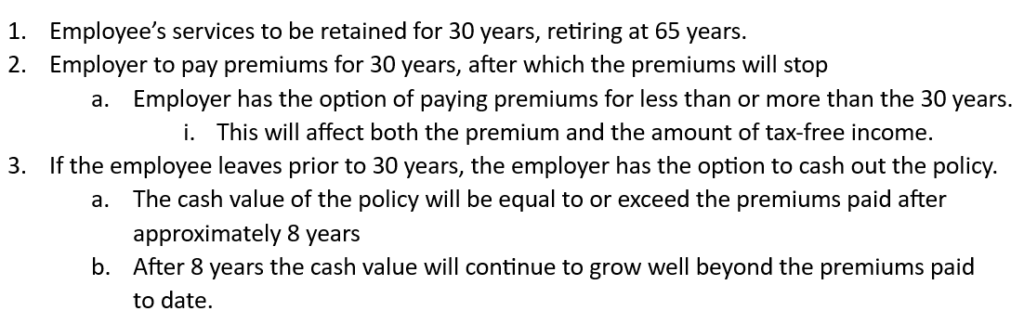
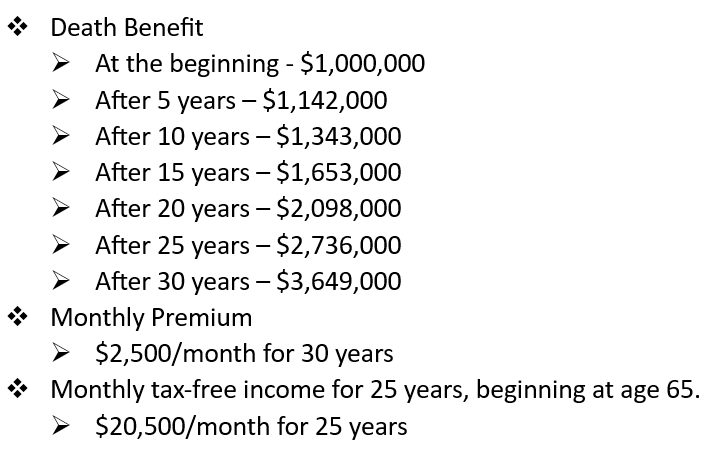
Dependent on the employee’s age and health, a cash-value life insurance policy can be taken out on that employee and paid for by the employer. This makes the employee the “insured” and the employer the “policy owner” and the primary beneficiary. The typical death benefit for this type of policy is $1,000,000 at the beginning of the policy. The policy can actually be taken out for less or more than the $1,000,000. The employee can contribute to the policy premium to the tune of how much death benefit does he/she want their family to get as opposed to how much the employer gets. This can be a part of the $1,000,000 or in addition to the $1,000,000.
Upon the successful completion of XX number of years of service to the company, the ownership of the policy can be transferred to the employee as a tax-free retirement package. This makes the employee the recipient of a tax-free income stream. A separate agreement between the “Key Person” and the Employer detailing the conditions under which the transfer was to take place needs to be in place in order to protect the rights of each.
Example: This example is based on a healthy 35-year-old male who is critical to the success of the business. This policy encompasses the following, all of which can be modified based on the employer’s and employee’s desires, understanding, and current circumstances:
All of the above is subject to the specifics of the employer’s/employee’s unique circumstances.
This concept can apply to corporate officers, business partners, or any individual who is critical to the continued and successful operations of the business.
In addition, this policy comes with a set of Living Benefits which includes a long-term care rider at no additional fees.
Please contact the Life Insurance Safe Zone to work up the policy specifics that will be based on your unique requirements.
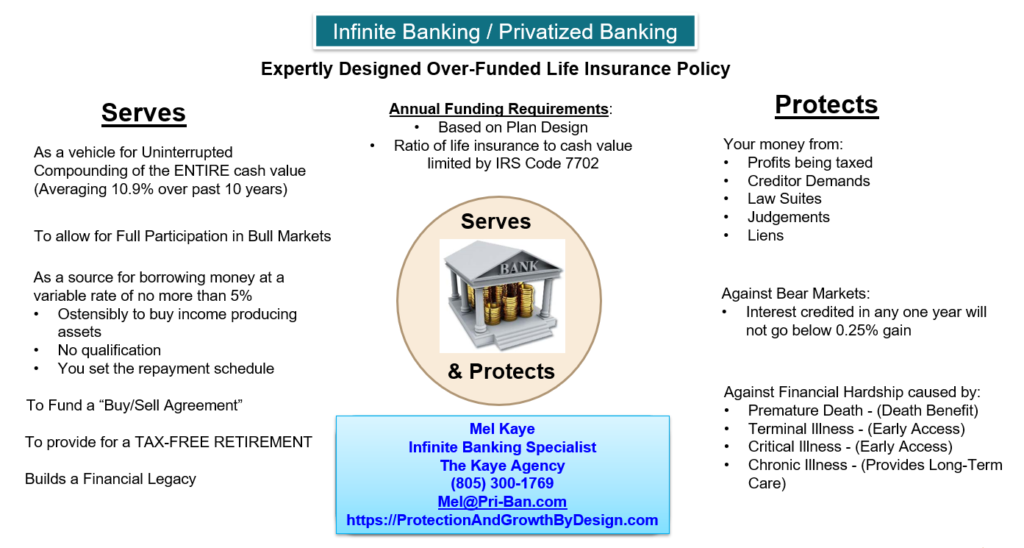
In addition to the multitude of benefits a “Pri-Ban” policy offers, one of the most beneficial for a business with multiple principals is the funding of “Buy/Sell Agreements” among the principals.
The Advantages of a Buy-Sell Policy
Helps prevent business failure upon the death of one of the owners.
Tax-free protection for the heirs of a deceased business Partner.
Ensures the continuity of business ownership and operational stability.
Reduces lender and trade creditor concerns over the company as a credit risk.
For those who are unfamiliar with these types of agreements, the following are some key features:
A chief concern among business owners is what will happen upon the death of one of the owners, and how will it affect the business, the other owners, and the heirs of the deceased owner. Surviving owners want to ensure the continuity of ownership, and not risk having a large share of ownership fall into the hands of potentially inexperienced heirs of the deceased. In addition, they want to protect themselves and the company financially. On a personal level, owners want to also ensure that their family is financially secure and compensated fairly in case something happens to them.
A buy-sell agreement can address all of these concerns. It is a contract among business owners that, upon the death of one of the owners, requires the remaining owners or the company itself to purchase the deceased’s interest in the company according to the agreed-upon terms of the contract. In addition, the deceased’s heirs are required to comply by selling their inherited interest at the previously agreed-upon price.
FUNDING BUY-SELL AGREEMENTS
There are various options for funding a buy-sell agreement, but some carry more risks than others. Some owners choose either to save money now and pay cash or to take out a loan to buy out a deceased owner’s share in the company. Both of these situations can be financially risky, both for the surviving owner(s) and the company itself.
The smartest method for funding a buy-sell agreement is through life insurance. This ensures that funds are immediately available when a death occurs; plus, death benefit proceeds are generally income-tax-free. In addition, the funds used to buy the deceased’s share are purchased for pennies on the dollar and the premiums will likely be significantly lower than the cost of repaying loan interest.
Types of buy-sell life insurance include the following:
Cross-Purchase Plans: Under this type of plan, the owners enter into an agreement with each other. Each owner purchases a life insurance policy on the other owners and will be named the beneficiary of the policy. Upon the death of an owner, each surviving owner receives life insurance proceeds income-tax-free and uses said proceeds to purchase the deceased’s business interests, while the heirs receive an agreed-upon payment for their business interest.
Entity Plans: In this type of agreement, also known as a stock redemption plan, the company purchases life insurance policies on each owner, with the company itself as the beneficiary. When an owner dies, the company receives the life insurance proceeds and uses said proceeds to purchase the deceased’s business interest, while the heirs receive an agreed-upon payment for their business interest.
Additional benefits of having Buy/Sell Agreements in place
There is a growing trend in the business credit community to require potential creditors to have buy/sell agreements in place before credit can be granted. When one of the principals of a business passes, too many times, it throws operations into turmoil, affecting their ability to honor their financial commitments. A fully funded plan to avoid operational interruption due to the death of a principal will enable the said business to obtain premium credit terms.
This post is a response to all those naysayers who say that an Indexed Universal Life (IUL) policy cannot, or should not, be used as an investment tool. Let’s be clear here, the IUL is a life insurance policy, but thanks to IRS code 7702, all of the interest benefits and perks found within the IUL can now be used for associated investment funds within the IUL. The investment funds within the policy are limited to an algorithmic calculation that a reputable life insurance agent should know how to calculate. The purpose of this calculation is to be sure that the policy does not become a MEC (Modified Endowment Contract) which is taxable. Following are the benefits of over-funding an IUL and using it as an investment vehicle and at the same time (Infinite Banking) using the policy to fund your business…..becoming your own bank.:
Uninterrupted compounding
Full (uncapped) Participation in bull markets
The IUL I use has shown a 10.9% average annual growth over the past 10 years.
Avoidance of the bear markets
The IUL I use has a floor of +0.25% (Still greater than a savings account)
The ability to borrow money from the carrier at no more than 5% interest per year
IMPORTANT – the borrowed funds do not affect the cash value earning an average of 10.9%/year (Non-Direct Loan Recognition)
This enables you to act like a bank (Infinite Banking), using your money to earn interest, while using the same money to ostensibly, buy income-earning assets.
Deferred taxes
Tax-Free retirement
In actuality, you are borrowing your money at no more than 5% while it continues to earn at an average of 10.9 % with no plans on paying it back.
The cash value within the life insurance policy is protected from:
Taxes
Creditor Demands
Lawsuits
Judgements
Liens
Your cash value is protected from financial hardships caused by:
The Generational Wealth, that the pundits talk about is the life insurance portion that is passed on to your heirs.
Yes, there are costs involved, the cost of the life insurance+. It is this very life insurance that enables all of the benefits listed above.
Depending on when you begin the policy, at the age of retirement, your cash value can be as much as 30 times your cumulative premiums. Let that sink in for a while.
Each client has different needs, requirements, budgetary restrictions, pressures, and plans, all of which MUST be taken into account when designing the policy. You NEVER want to allow the policy to lapse. If it lapses, you still can get your cash value, but it can become taxable.
If used correctly and designed with proficient understanding, the IUL can be your BEST and most predictable investment.
As always, contact me if you would like me to design a plan for you……You will be amazed.
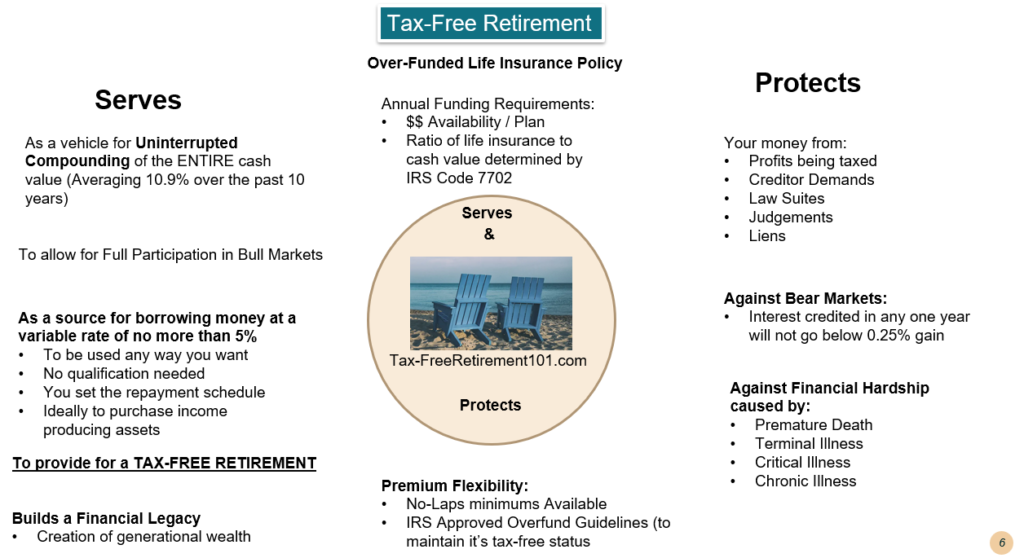
One of the benefits of Infinite Banking is “Tax-Free Retirement.” Since the end results are based on a plan design that is tailored specifically for you, please contact us and let us design a plan for you.
Information concerning tax or estate planning should not be considered tax or legal advice. Clients should consult their own tax professional or attorney regarding their unique situation.
You are actively seeking the optimal life insurance policy tailored for Privatized Banking, a task that requires a precise selection. Your aim is to secure a specific type of life insurance that grants you accessible cash reserves, consistent compounding without interruption, and the ability to leverage your funds in dual capacities.
Life insurance stands as a potent tool, capable of serving multifarious purposes concurrently. Yet, sculpting a life insurance policy to unlock its full potential demands a deft touch.
Among the array of available policies, one variant shines as the premier choice for Privatized Banking when enhanced with performance-oriented adjustments. This distinctive configuration guarantees an elevated initial cash value, and it maximizes long-term growth, all the while upholding its tax advantages.
Another variety of policy also thrives as a Privatized Banking platform. Diverging from the former, this one necessitates up to a year before your cash value becomes accessible. It exhibits variable annual returns, yet its potential for long-term growth surges up to 4% beyond the other platform, while still retaining its tax benefits.
Why You’re Funding a Privatized Banking Policy
Let’s step back for a moment to establish some context.
Assuming you have the funds available for investment, your intention is to avoid depleting your savings account to make the investment. Your goal is to maintain control over your capital and optimize the long-term efficiency of your overall financial situation using the Infinite Banking Concept. This approach offers a combination of safety, growth, and accessibility to your funds.
To put this strategy into action, you will initially place your capital within a life insurance contract.
When the time comes to make an investment, you will utilize a guaranteed loan feature to borrow against the cash value of your policy. The advantageous aspect is that you can choose a repayment pace that suits your preferences.
By employing your capital as collateral instead of spending it outright, you will continue to accrue uninterrupted compound interest even as you make investments. This dual benefit allows you to achieve returns from two sources simultaneously.
Now, as you prepare to acquire a policy to facilitate these objectives, what criteria should you consider?
Your Questions About What Kind of Policy to Use for Privatized Banking, Answered
If you’ve ever spent a minute shopping for life insurance, the process can be downright overwhelming. It’s easy to feel like the assortment of options is like Baskin Robbin’s 31 flavors. All might be good, but which one is best?
Today, we’ll answer your most important questions about Privatized Banking policies:
What kind of life insurance policy do I need?
What are the essentials to make sure the policy performs best?
Can I use any cash value life insurance product?
What makes the policy specially designed?
How do I ensure it won’t take forever to build up cash value and I can use my cash quickly to invest in opportunities?
You’ll find out the three major types of life insurance, and why only one works for Privatized Banking. You’ll discover the only kind of insurance company you want to work with. And you’ll learn what makes a policy specially designed so that it becomes a great place to store cash.
Instead of being overwhelmed with minor details, you’ll know exactly what you want and what to focus on.
Where Privatized Banking Fits into Your Cash Flow System
There are four primary types of life insurance: term, accidental death, universal, and whole life insurance. All types have a purpose, solving problems for a part of the population, but only two do Privatized Banking well.
Term Insurance
The first type is term insurance. It covers you for a specific timeframe, known as the term of the policy. The term is generally 10 or 20 years, but it can be as short as 1 year and as long as 30 years.
During this term, it provides a death benefit to your heirs, if you pass away. There are policies, which I provide, that also have accelerated death benefits. These provide access to the death benefit while you are still alive for terminal illness, critical illness and chronic illness.
That’s it. No bells or whistles. No cash value or benefit after the term is over. And no money back.
The greatest advantage of term insurance is that it provides a lot of death benefit at a low premium, especially if you are young and healthy.
But the downside is that if you buy a term policy, you’ll likely never get the death benefit. That’s because historically, only 1 – 2% of term policies pay out. The other 98% of policies expire while the insured is still alive, or they are converted to permanent policies. The actuarial data used to set rates does a great job of providing the best rates to people statistically likely to outlive the term.
A term policy doesn’t vanish after the term. That’s because it often comes as a guaranteed renewable term policy, giving you the option to renew the policy at a new rate once the term is over, without having to go through underwriting again.
However, once the term is up and you want to renew the policy, you’ll see a steep rate increase that will continue to rise each year. This is due to the annually renewable term policy that will be in force after the original term expires.
For instance, one $750,000 term policy cost $606/year during the term. The owner, now age 59, facing an expiring term, had the option to continue the same policy at a premium of $22,000/year.
Term Insurance and Privatized Banking
When it comes to Privatized Banking, term as a stand-alone policy won’t suffice. With term, there’s no cash value to use – and cash value is the bread and butter of Privatized Banking.
However, term insurance is a powerful supplement to maximize your coverage up to your Human Life Value right away. It lets you open future cash value policies, even if your health falters before you get that opportunity.
You do this with a convertibility feature. This means you can convert the term policy to a permanent policy at any point during the term. At conversion, you would then pay a new premium, but get to keep your original health underwriting status. This is a huge bonus to someone who started a convertible term policy, who may later be diagnosed with a condition, and yet still maintains the ability to be rated with their original health status when they convert. This ensures they still qualify for coverage and will pay lower rates (lower than they would if they went through a health-based qualification) on the new permanent policy.
Universal Insurance
Universal life insurance originated in the 1970’s and 80’s. The coverage is built on an annually renewable term life insurance chassis, with an accumulation fund that has additional ways to build up cash value inside. You can accumulate money tax-advantaged, but the cost of insurance increases each year, which may require an increase in premium to keep the policy in force.
While maintaining a moderate price point, it has the potential to earn high rates. Premiums above the cost of insurance create cash value you can use.
With universal life insurance, you have adjustable premiums and an adjustable death benefit.
Universal life insurance comes in three main varieties: traditional universal, variable universal, and equity-indexed universal life insurance.
Here’s a brief look at each one.
Traditional Universal Life (UL)
With a traditional universal life policy, your premium grows interest-rate sensitive to create cash value.
The policy is built upon the assumption of what interest rates will do in the future, to maintain the proper ratios of premium to death benefit, so the policy doesn’t lapse. If interest rates fall, the policy may require more cash than illustrated.
Many unfortunate and unsuspecting people holding universal policies into their 70’s and 80’s discovered that lower than expected interest rates had failed to create the growth needed to maintain the death benefit. They found that they could not keep up with the increased premium cost. Many were forced to cancel their universal policies at a time when they needed life insurance the most. These were not policies used for Infinite Banking. The Infinite Banking policies are dramatically over-funded giving them more than enough to cover the occasional down years.
An Infinite Banking policy is not a year-to-year type policy. It is a long-term play with the short-term borrowing ability at a rate, usually less than the interest earned on the entire cash value, regardless of any outstanding loans.
Variable Universal Life (VUL)
In the 80’s, the stock market took off, and people began taking cash out of universal and whole life policies and putting it into the stock market.
Instead of giving up market share, the insurance industry responded by getting into the investment world. A new policy structure of variable universal life was born. In this product, cash value was not in an interest product, but placed into the stock market.
Then, in 2001, with the dot-com crash, these insurance policies needed more premiums to keep from lapsing.
In addition to the flailing performance, these policies had more built-in costs, because there are investment costs along the way also.
Equity-Indexed Universal Life (EIUL)
Another product was created in response to people losing a lot of money in variable universal life.
Equity-indexed universal life seemed more appealing because it gave you access to market returns, without as much risk.
Rather than have the market exposure of VUL, equity-indexed universal life gives you a built-in floor and ceiling on your cash value growth. The floor protects your money from losing value, but you are capped on the upside.
Rather than being invested directly in mutual funds, your accumulation fund is invested in an equity index account. Cash value growth is based on the performance of an index, although the funds are not directly invested in the stock market.
EIULs still come with increased internal costs. To hedge against the loss, they have to use complex investing strategies using options, which run up operational costs.
Owners of EIUL policies are counting on average rates of return. But returns haven’t been as high as anticipated. Additionally, if you borrow, or have lower performance than illustrated, the policy may require additional cash over and above the illustrated premiums.
A Note About Variable Life Insurance
At about the same time that universal life insurance came on the scene, variable life insurance was also introduced. Variable life insurance is very similar to variable universal life, but offers a fixed premium, a flexible death benefit, and the ability to earn a variable rate of return.
Universal Life, Variable Life, and Privatized Banking
While universal and variable life insurance policies do have a cash value component, these policies are not appropriate for Privatized Banking. Privatized Banking requires a solid foundation of predictability, certainty, and guarantees so that you maintain control.
With universal life insurance, you don’t get 100% certainty that the cash value will remain steady, or that the premium illustrated will be sufficient. Therefore, you don’t have the performance guarantees that optimize your control. @@
Whole Life insurance
Whole life insurance is a truly permanent coverage. It has a guaranteed consistent premium, a guaranteed death benefit, and guaranteed cash value, throughout your entire life.
Not only do you have a death benefit you can rely on, but you also have reliable cash value you can use while you’re alive.
Let’s take a closer look at the guarantees.
Premiums
First, premiums are level. They’re guaranteed to never increase in order to maintain the death benefit.
On the price-point spectrum, whole life starts higher than other types of life insurance.
Actuaries determine the death benefit, based on what you would like to place into the policy.
The 1-year renewable term is spread over the contract period (121 years), leveling out the cost of insurance over that time period. They know that early on, your insurance costs are lower, and as you get older, the costs rise. They spread these costs out over entire contract, giving you the certainty that your premiums are not going to increase.
Cash Value
Then, the cash value grows with a guaranteed minimum return over time.
Like building equity in a house, the cash value continues to rise over time until it equals the death benefit.
Death Benefit
Finally, as long as you keep the policy in force, it’s guaranteed to payout.
The “end” of a whole life policy is the “age of endowment.” This marker in a whole life policy is important because it’s essentially a maximum life expectancy year imprinted on all policies. For instance, policies used to illustrate to age 100, but now have extended to age 121 in most cases, to account for increased life expectancies.
If the policy owner reaches the age of endowment alive, the entire cash value will payout to them directly.
Whole Life Insurance and Privatized Banking
Privatized Banking does work best with guarantees in what your cash value will be, and whole life is the only life insurance product that can rise to this occasion. However, Indexed Universal Life also works well for Privatized Banking. We will get into a comparison between the two types later on in this post.
With whole life insurance, you have 100% certainty that if you put in what’s illustrated, the policy will perform as illustrated.
Now, moving on to the good stuff.
To maximize your cash value and usability, you want to ensure your whole life policy is specially designed, with a specific type of company, and specific high-performance modifications.
The Only Type of Whole Life Insurance Company You Want to Work With
There are two types of life insurance companies: stock companies and mutual companies.
You only want to work with a mutual company, and here’s why:
The category determines who receives the profits of the company and how that impacts your cash value.
Stock companies are owned by the stockholders, while mutual companies are owned by the policy owners.
A stock company has loyalty to stockholders and pays them dividends when the company is profitable.
Likewise, a mutual company pays dividends when profitable, but to policy owners.
In addition to dividends, policy owners also get voting rights in a mutual company. They can exercise their say in the leadership, ownership, and relevant decisions of the company with an annual vote.
How Dividends Work
As a policy owner, you pay a premium and gain ownership of a part of the company based on your death benefit.
Then, at the end of the year, the board of directors analyzes their profitability.
They first look at the cost to run the company. This includes maintaining the service force to service the policies from the headquarters, paying people who sell policies in the form of commissions, and calculating how much they paid out in death claims.
Then they assess the input of premium and how it performed.
Life insurance companies have a long-range, conservative investment structure that allows them to make performance guarantees. Most premium dollars are employed in highly-rated bonds – highly-rated corporate bonds, treasuries, and municipal bonds. The rest is deployed in real estate projects, with a tiny sliver in securities-related products.
They determine profits, place a portion in reserves, and declare the rest as a dividend rate. The dividend is then paid to policyholders.
How Dividends Increase Your Policy’s Performance
Dividends are not a guaranteed part of the policy. Instead, they make up a part of your non-guaranteed portion of the illustration.
However, because of the highly controlled fiscal environment of a life insurance company, profits tend to mirror projections closely. Because of this certainty, dividends are highly anticipated to be paid out. This expectation is confirmed by the consistent payment of dividends every single year, even throughout the Great Depression, by the stable and long-standing companies that we do business with.
Once the dividend is declared, the policy owner then has several options in how they would like to receive the dividend payment. The best option directly increases your cash value, while also adding more death benefit.
And unlike a stock dividend, which can fluctuate in value after it’s assigned, a mutual life insurance dividend that’s added to your cash value sets a new cash value floor. The cash value can never drop below that line in the future.
The Tax Advantages of Specially Designed Life Insurance
With specially designed whole life insurance, you gain significant tax advantages. If the policy is utilized correctly, you aren’t taxed on the growth, and you can use it tax-free.
For this benefit, you pay tax on premium dollars before you put them in the policy.
Then, your cash value grows tax-deferred, so you don’t owe tax on the growth each year.
You can use the cash value through loans completely tax-free.
And when the death benefit is paid to your heirs, it’s completely income-tax-free as well.
It’s a triple-tax advantaged asset that you pay tax on the seed, but not the harvest.
However, there are two primary ways to trigger a taxable event inside of a specially designed policy, and both are avoidable.
One taxable event would be accessing cash value through withdrawals (different than a loan) above your cost basis (what you paid in).
The other taxable event would be if your policy becomes a Modified Endowment Contract (MEC) by having too little death benefit to support the infusion of cash.
If your policy becomes a MEC, the tax structure changes, becoming similar to a 401k or qualified plan, where you have to pay tax when you use your money. Policies are monitored with MEC tests to raise the death benefit correspondingly, so you overfund up to the maximum without crossing the MEC line.
What Are the Essentials to Make Sure the Policy Performs Best?
Let’s pull all these strings together into what is required to ensure a policy performs best and delivers the control and certainty you need for Privatized Banking.
We’ll create a sort of virtual reality map that will give you the ability to look at the real world with labels marking everything important.
We want to help you recognize the 4 crucial elements of a Privatized Banking policy, so you can quickly and easily determine if the policy measures up and gives you what you’re looking for.
Premium – the policy has a guaranteed premium that will never increase
Cash value – you have a minimum guaranteed cash value that will continue to grow
Dividends – the policy illustrates non-guaranteed, but highly-anticipated dividends, which increase the cash value
Now that we’ve covered the basics, let’s dive into optimizing your policy. To perform Privatized Banking best, your policy needs a special design and modifications to jumpstart and accelerate early cash value.
How Do I Build Cash Value Quickly to Invest in Opportunities?
Whole life has fallen out of favor over the years because people have become enamored with rates of return.
However, utilizing a specially designed policy with Privatized Banking gives not only competitive returns but much more.
You also gain uninterrupted compounding, certainty, and the ability to access your capital by collateralizing your policy. By keeping your own cash, and putting someone else’s to work in another asset, you gain the advantage of earning returns in two places at the same time.
While a standard whole life insurance policy takes many years to build up enough cash value to write home about, a specially designed policy is different. With some intentional and strategic policy design, your cash value can quickly overcome the costs and exceed the amount you’ve paid in premium.
How does it work?
What Makes the Policy Specially Designed?
The funding structure of a specially designed policy accelerates your cash value by combining three different types of premiums within your policy.
First, base premium provides a base policy and maximizes the death benefit.
Next, a term rider boosts the death benefit to satisfy the MEC rules.
Finally, level paid-up additions riders supercharge the cash value by purchasing little mini paid-up policies.
Because you’re overfunding the death benefit, the death benefit continues to rise over time, while you’re also building cash value.
Flexibility in How Long You Pay Premiums
While most people find it difficult to plan a specific funding level for the rest of their life, unaware of how their circumstances may change, there’s flexibility in how you pay premiums.
It is possible to illustrate funding a policy for as long as your whole life, or in as little as 3 years. If you overfund early, you can tell the company to reduce the death benefit so that it’s fully paid up, with no more future premiums due.
This option is available for both the Participating Whole Life and the Indexed Universal life policies.
Storing Your Money in Life Insurance Is Similar to Storing Your Money in the Bank, Only Better
The goal of Privatized Banking is to maximize the cash value in the early years so you can be your own banker, mimicking a place to store money like you’d store it in a bank.
Why not store in a bank? Let’s look at the pros and cons of each in comparison.
The Bank
In a bank, your money is easily accessible, so you have control.
It’s backed by the FDIC, so it’s generally safe. However, if you look at the reserves of the FDIC, they are minimal, compared to the deposits they back. If a crisis required using the FDIC to fulfill depositor’s claims, the government would print money to cover it, putting more money into circulation and causing inflation, so your money would be worth less.
In a bank, you do get a rate of return, although, for most banks, it’s currently well below 1%. And you will have to put the growth on your tax return because it’s taxable.
The primary downside of using the bank is that if you take money out, you stop earning a return on the portion you removed. The opportunity cost of using your cash is that you give up the compounding effect, and you’re never able to earn on that same cash again.
Participating Whole Life Insurance and Indexed Universal Life Insurance Contracts
In a participating whole life insurance contract that has been specially designed, the internal rate of return averages between 2-6%, at least 100X more than a bank. In a specially designed indexed universal life insurance contract, the internal rate of return averages between .25-12+%, averaging between 25 to 250X more than a bank. That growth, when designed and used properly, is not taxable.
Guaranteed Access Interest
You will be charged interest on this loan. Some people wonder why you would want to pay interest on your own money. Factually, you’re not. Rather, you’re paying interest to use the life insurance company’s money.
Let’s explain.
If you have $100K cash value and request a $50K loan, the full $100K continues to earn interest and dividends. Why? Because you did not take your money out. You used your cash as collateral and took a loan from the life insurance company. This allows your money to keep growing, which is the ticket to uninterrupted compound interest. This loan is referred to as Non-Direct Loan Recognition.
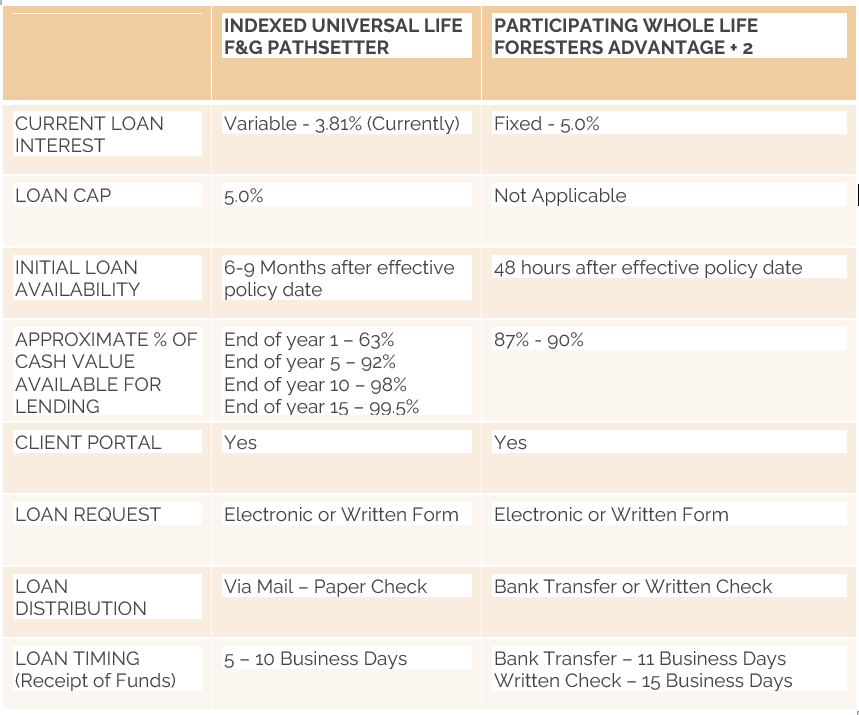
With the insurance carriers that I use, the participating whole life has a fixed interest rate of 5%. With the fixed indexed universal life company, the rate is variable, capped at 5%, and at the time of this writing, is 3.61%.
Flexible Repayments
When it comes to repaying the loan, you get options there, too.
You can choose to pay back all at once or on a schedule of your choosing.
While interest does continue to accrue as long as there’s an outstanding loan, you have the option to let it accrue without paying it for a time, as long as you have a sufficient cash value buffer above your loan to prevent the policy from collapsing.
The Limiting Factor Is Your Thinking
Using Privatized Banking with life insurance is really about how you think.
Everybody has banking in their lives. Banks are profitable.
If you can recapture the banking function in your life, you can recapture some of that profitability, while at the same time, getting protection for your income.
Your Decision Point
Empowered with this information, you now have a choice. Both the Indexed Universal Life policy and the Participating Whole Life policy will work for Privatized Banking (Infinite Banking). The important aspect is to know what you want to accomplish and have a plan. With a plan you are better able to choose between the two.
If you’re shopping for your first Privatized Banking policy or adding on another policy, you have the framework to go from overwhelmed to crystal clear on exactly what you want. You’re able to make decisions quickly and easily, knowing how to focus on what’s most important instead of the minor details. Even though I have access to a multitude of policies, I have narrowed the choice down to the following two:
Foresters Advantage Plus II Participating Whole Life Policy
F&G Pathsetter Indexed Universal Life Policy
Both have consistently generated the highest returns in their industries.
The following is a rough comparison between the two policy types.
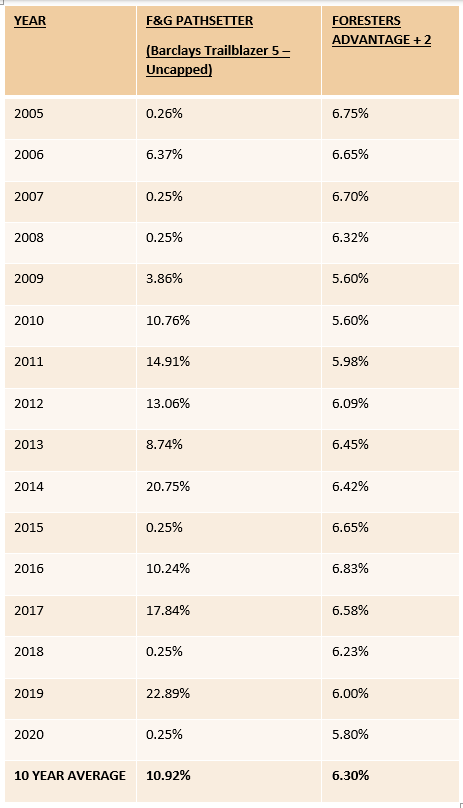
Here is a chart that shows the average gains for each policy type over the past 10 years+.
The Foresters program is more consistent in its returns.
The F&G program is much more inconsistent, but its long-term average returns are much higher.
In both cases, no matter how bad the market gets, the decline can never go below a 0.25% gain, which is still well above a traditional savings account.
If you’re wishing you knew this a long time ago, and you already have a different type/design of life insurance, it’s not always a good idea to throw in the towel and start from scratch. Let me help you through a strategy to take the next best steps, starting from where you are now.
I will work with you to design a plan that fits your needs and helps accomplish both you short and long-term goals.
The History of Infinite Banking, or the concept of Infinite Banking gained prominence through Nelson Nash, who introduced it in his publication titled “Becoming Your Own Banker.” Nelson Nash, a veteran Life Insurance Agent with decades of experience, authored and published the book. The ideas and methodologies outlined in the book had been integral to Nash and his family’s financial approach since the early 1980s.
Presently, individuals who discuss the idea and practice of employing high cash-value life insurance as a personal financial resource (referred to as Infinite Banking or Privatized Banking) generally employ the terminology originally introduced by Nash in his initial edition.
Becoming Your Own Banker was published in 2000, and since then Nash has updated the book four times. The 5th Edition of the book is currently available on Amazon. Since then a few other people have followed suit and written their own version of the concept.
One of the more popular books Bank on Yourself by Pamela Yellen, was published in 2009, and shares much of the same information presented in Nash’s book. The book also happens to be one long sales pitch for contacting her organization and working with one of her partners.
The books on Infinite Banking will provide the reader with the basic concepts, the typical vehicle for banking (permanent life insurance), and various comparisons with other forms of financing or banking. But the reasoning behind this concept is much older than Nash or even his parents. The foundation of Infinite Banking is a school of economics called The Austrian School.
Austrian Economics
Austrian Economics is a school of economic theory that was founded by the Austrian Carl Menger. The school of thought was “founded” when Menger published his first book Principles of Economics in 1871, effectively criticizing the classical theory of economics that was commonly held at the time.
Menger proposed the “Subjective Theory of Value,” which stated that the price of a given service or good was NOT the cost to produce it (as proposed by classical economists), but the subjective price that someone was willing to pay. Many famous economists have followed and promoted his school of thought, such as: Ludwig Von Mises, Murray Rothbard, and Friedrich Hayek.
The Austrian school is foundational to Infinite Banking in that it views the Boom and Bust cycle (that most Americans have come to accept as inevitable), as nothing more than the unwanted result of excess bank credit in the economy.
Infinite Banking practitioners revel in the fact that they bank with insurance companies that are privately held and have a 100% reserve requirement on the money they loan. This is in sharp contrast to the fractional reserve banking system that is pervasive in the world and typically has a 10% reserve requirement, and therefore creates excess credit and consequently the boom and bust cycles.