Section 7702 of the U.S. Internal Revenue Service (IRS) Tax Code defines what the federal government considers to be a legitimate life insurance contract and is used to determine how the proceeds the policy generates are taxed.
The proceeds of policies that do not meet the government’s definition are taxable as ordinary income. Proceeds from genuine life insurance contracts are tax-advantaged. Section 7702 applies only to life insurance contracts issued after the year 1984.
KEY TAKEAWAYS
Section 7702 of the Tax Code differentiates between income from a genuine insurance product and income from an investment vehicle.
Certain types of permanent life insurance build up a cash value over time.
The proceeds of a true life insurance contract receive favorable tax treatment.
The proceeds of a contract that does not meet the IRS definition are taxed as ordinary income.
An insurance policy that fails Section 7702 criteria becomes a modified endowment contract (MEC) and permanently loses its tax-advantaged status.
Understanding Section 7702
Prior to the adoption of Section 7702, federal tax law took a fairly hands-off approach when it came to the taxation of life insurance policies. Death benefits paid to life insurance beneficiaries were exempt from income tax, and any gains that accrued within the policy during the policyholder’s lifetime were not taxed as income.
While this favorable tax treatment may look reasonable on its surface—the government did not want to be seen taxing needy widows and children—problems arise when the system can be rigged, such as when other types of investment accounts are passed off as life insurance products.
To prevent this from happening, Section 7702 created a list of requirements used to ensure that only genuine life insurance policies received advantageous tax treatment and not investment vehicles masquerading as them.
Requirements of Section 7702
Life insurance contracts have to pass one of two tests: the cash value accumulation test (CVAT) or the guideline premium and corridor test (GPT).
Cash Value Accumulation Test
The cash value accumulation test stipulates that the cash surrender value of the contract “may not at any time exceed the net single premium which would have to be paid at such time to fund future benefits under the contract.”
That means that the amount of money a policyholder could get out of the policy if they were to cancel it (often referred to as the “savings” component of cash value life insurance) can’t be greater than the amount that the policyholder would have paid to purchase the policy with a single lump sum, not including any fees.
Guideline Premium and Corridor Test
The guideline premium and corridor test requires that “the sum of the premiums paid under such contract does not at any time exceed the guideline premium limitation as of such time.” This means that the policyholder can’t have paid more into the policy than would be necessary to fund its insurance benefits.
If a life insurance policy fails to pass either of those tests, Section 7702(g) stipulates that the income on the contract will be treated as ordinary income for that year and taxed accordingly. In other words, the owner of the contract will lose the favorable tax treatment of a true life insurance policy.1
Why Are Permanent Life Insurance Contracts Given Favorable Tax Treatment?
Life insurance contracts are intended by design to provide a cash benefit to one’s beneficiaries when they pass away. While the insured is still alive, permanent life insurance contracts like whole or universal life can accumulate a cash value that can be withdrawn or borrowed against. But, because these contracts are viewed as insurance, and not as an investment, they are granted certain tax benefits. A policy loan, for example, is received tax-free.
A modified endowment contract (MEC) is a permanent life insurance policy that fails the Section 7702 criteria because it has been “overfunded” with too much cash value relative to the size of its death benefit, as defined by IRC Section 7702a. Rules set out by the Technical and Miscellaneous Revenue Act of 1988 (TAMRA) specify a seven-pay test, whereby premiums paid into the policy cannot exceed the total amount that would be needed to have the policy fully paid up within seven years.2 If an insurance policy becomes a MEC, it loses its tax advantages and cannot revert back to a non-MEC status.
When Was Section 7702 of the Tax Code Written?
Section 7702 and all related subsections were enacted in 1984.
A modified endowment contract (MEC) is a tax qualification of a life insurance policy whose funding exceeds federal tax law limits. The taxation structure and IRS policy classification change after a life insurance policy morphs into a modified endowment contract.
KEY FACTS
A modified endowment contract (MEC) is the term given to a life insurance policy whose funding has exceeded federal tax law limits.
The policy must fail to meet the Technical and Miscellaneous Revenue Act of 1988 (TAMRA) seven-pay test.
The taxation of withdrawals under the MEC is similar to that of non-qualified annuity withdrawals.
Understanding Modified Endowment Contracts (MEC)
A modified endowment contract (MEC) happens when the IRS no longer recognizes a policy as a life insurance contract because the total collected premiums exceed federal tax law limits. This classification seeks to combat calling something “life insurance” to avoid taxes.
Specifically, a life insurance policy is considered a MEC by the IRS if it meets three criteria:
The policy is entered into on or after June 20, 1988.
It must meet the statutory definition of a life insurance policy.
The policy must fail to meet the Technical and Miscellaneous Revenue Act of 1988 (TAMRA) 7-pay test.
The seven-pay test determines whether the total amount of premiums paid into a life insurance policy, within the first seven years, is more than what was required to have the policy considered paid up in seven years. Policies become MECs when the premiums paid to the policy are more than what was needed to be paid within that seven-year time frame.1
The IRS requires a life insurance policy to comply with a strict set of criteria in order to qualify as a MEC.
Life insurance policies entered into before June 20, 1988, are not subject to the payment of premiums over the money allowed under federal laws. However, the renewal of an older life insurance policy after this date is considered new and must be subjected to the seven-pay test.
Tax Implications of an MEC
The taxation of withdrawals under the MEC is similar to that of non-qualified annuity withdrawals. For withdrawals before the age of 59 1/2, a premature withdrawal penalty of 10% may apply. As with traditional life insurance policies, MEC death benefits are not subject to taxation. Modified endowment contracts are usually purchased by individuals who are interested in tax-sheltered, investment-rich policies, and do not intend to make pre-death policy withdrawals.2
Unlike traditional life insurance policies, taxes on gains are regular income for MEC withdrawals under last-in-first-out (LIFO) accounting methodology. However, the cost basis within the MEC and withdrawals is not subject to taxation. The tax-free death benefit makes MECs useful for estate planning purposes, provided the estate can meet the qualifying criteria. Furthermore, policy owners who do not take withdrawals can pass on a significant sum of money to their beneficiaries.
What are the likely tax consequences of an early withdrawal under a MEC?
Withdrawals are taxed similarly to those of a non-qualified annuity. For withdrawals before the age of 59 1/2, a penalty of 10% may apply. As with traditional life insurance policies, MEC death benefits aren’t subject to taxation.
How are taxes on gains figured in a MEC?
Taxes on gains are regular income for MEC withdrawals under last-in-first-out accounting methodology. However, the cost basis within the MEC and withdrawals is not subject to taxation.
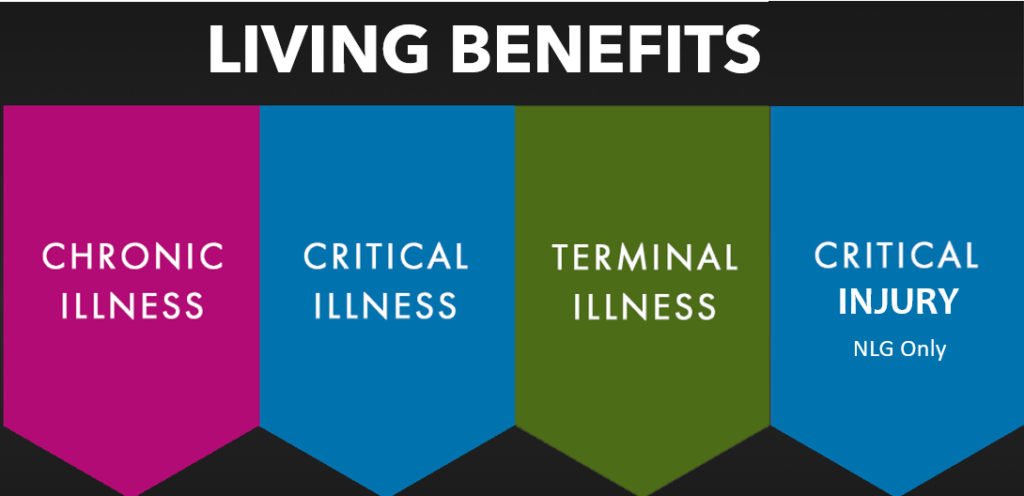
An advance cash payment of a portion of the insurance before the insured person dies. It allows for financial assistance to the insured individual while he or she is still alive. Not all policies will cover all 4 categories. There are 4 typical categories of Living Benefits:
Terminal Illness
An insured has a terminal illness if they have been diagnosed and are suffering from a terminal illness that will result in death within 24 months (typically) with certification of the terminal illness by a physician.
Critical Illness
An insured qualifies under the Critical Illness for: • Diagnosis of ALS (Lou Gehrig’s disease) • Blindness • Diagnosed with cancer • Diagnosis of End-stage renal failure (kidney failure) • Heart attack • Major organ transplant • Stroke
Critical Injury
An insured qualifies under the Critical Injury rider for: • Coma • Paralysis • Severe burns • Traumatic brain injury. The vast majority of carriers do not cover critical injury. The only one that I have found that covers critical injury is National Life Group
Chronic Illness
Being chronically ill means you’re unable to perform at least two of the Six Activities of Daily Living (eating, bathing, getting dressed, toileting, transferring, continence)
Even though this site is dedicated to Advanced Life Insurance Solutions, it is important that you have a definition reference for terms that you may not be familiar with.
Administrative Expense
The life insurance company’s operating costs. It covers salaries, medical examinations, building rent, underwriting, advertising, printing costs, agency expenses and premium taxes. These expenses get lumped into what you pay and are used to calculate dividends and premium rates.
Accelerated Death Benefits (AKS “Living Benefits”)
The death benefits that are available prior to the death of the insured. Sometimes called Living Benefits, they are usually accessible in cases of chronic illness, terminal illness, critical illness, or critical injury.
Accrued Interest
Interest that has been earned and recognized but not yet paid out (or the borrower has not received the payment).
Agent
A person licensed by the state to negotiate insurance contracts. An agent can be independent and represent multiple companies, or a direct writer who sells policies for only one company.
Amount of Insurance
The coverage that is issued by a life insurance company. Also called the Coverage Amount, Face Amount, or Sum Insured.
Annuity
A contract that pays a fixed sum of money at regular intervals, usually for life.
Annuity Certain
A contract that pays an income for a set number of years and will pay the annuitant’s beneficiary or estate if the annuitant dies before the end of the payment term.
Application (AKA “Approval Request”)
A statement of information made by a person applying for life insurance. Life insurance companies use the information from applications to determine the risk of each would-be policy-owner. Companies then determine an applicant’s underwriting classification and premium rates.
Assignment
The legal transfer—to another person or to an entity like a financial institution—of the claim rights an individual has on an insurance policy. This is done to qualify for a loan.
Banking
business conducted by a bank (i.e. receive deposits and make loans).
Beneficiary
The individual who receives proceeds from a life insurance policy at the death of the insured. A beneficiary who is less than 18 years old must be represented by a legal guardian or a public official. Anyone can be named as a beneficiary.
Billing Date
The day of the month that the life insurance premium bill is due. (You’ll want to keep track of this to make sure your policy doesn’t lapse!)
Blended Policy
A creative way of combining a “Term” policy and a “Perm” policy providing you your desired death benefit and gives you back your cumulative premiums at the end of a certain amount of years (usually between 20 & 30) if the insured does not die.
Bonus Rate Annuity
An annuity carrying an extra-high interest rate offered for only the first year, to attract new policyholders.
Buy/Sell Agreements
A chief concern among business owners is what will happen upon the death of one of the owners, and how will it affect the business, the other owners and the heirs of the deceased owner. Surviving owners want to ensure the continuity of ownership, and not risk having a large share of ownership fall into the hands of potentially inexperienced heirs of the deceased. In addition, they want to protect themselves and the company financially. On a personal level, owners want to also ensure that their family is financially secure and compensated fairly in case something happens to them.
A buy-sell agreement can address all of these concerns. It is a contract among business owners which, upon the death of one of the owners, requires the remaining owners or the company itself to purchase the deceased’s interest in the company according to the agreed-upon terms of the contract. In addition, the deceased’s heirs are required to comply by selling their inherited interest at the previously agreed-upon price.
FUNDING A BUY-SELL AGREEMENT
There are various options for funding a buy-sell agreement, but some carry more risks than others. Some owners choose either to save money now and pay cash or to take out a loan to buy out a deceased owner’s share in the company. Both of these situations can be financially risky, both for the surviving owner(s) and the company itself.
The smartest method for funding a buy-sell agreement is through life insurance. This ensures that funds are immediately available when a death occurs; plus, death benefit proceeds are generally income-tax-free. In addition, the funds used to buy the deceased’s share are purchased for pennies on the dollar and the premiums will likely be significantly lower than the cost of repaying loan interest.
Types of buy-sell life insurance include the following:
Cross-Purchase Plans: Under this type of plan, the owners enter into an agreement with each other. Each owner purchases a life insurance policy on the other owners and will be named the beneficiary of the policy. Upon the death of an owner, each surviving owner receives life insurance proceeds income-tax-free and uses said proceeds to purchase the deceased’s business interests, while the heirs receive an agreed-upon payment for their business interest.
Entity Plans: In this type of agreement, also known as a stock redemption plan, the company purchases life insurance policies for each owner, with the company itself as the beneficiary. When an owner dies, the company receives the life insurance proceeds and uses said proceeds to purchase the deceased’s business interest, while the heirs receive an agreed-upon payment for their business interest.
The cash amount you would get if you voluntarily terminate coverage before a policy becomes payable by death or maturity. The amount is the cash value stated in the policy, minus a surrender charge, any outstanding loans and interest on those loans. The cash value represents the savings component of a life insurance policy, since you can access the money relatively quickly if you need to.
Collateral Assignment of Life Insurance
A contract that gives a lender claim to a life insurance policy death benefit as collateral for a loan.
Concept
An idea, a plan, a process, or an understanding based upon an experience, reasoning, and/or imagination.
Contingent Beneficiary
A contingent beneficiary receives your life insurance death benefit if your primary beneficiary dies before you. Naming a contingent beneficiary keeps the benefit out of probate court.
Contingent Owner
The person who will become the owner of a life plan if the original owner dies before the policy ends.
Conversion Right
The right – granted by some term life insurance policies – to change the current policy of an individual to a permanent insurance policy within a certain timeframe, without giving proof of insurability.
Cost of Insurance
The amount an individual must pay for his/her life insurance policy, also known as a premium. The monthly charge for a life insurance policy fluctuates depending on the insured person’s health, age, sex and other considerations such as lifestyle and the nature of the person’s profession. Poor health and extreme hobbies are likely to increase the cost of insurance—or may even lead to denial of coverage altogether.
Coverage Period
The period of time the life insurance covers the policy-holder.
Coverage End Date
The day the insurance coverage ends.
Coverage Start Date
The day the insurance coverage becomes effective.
Critical Period Mortgage Protection
Critical Period Mortgage Protection insurance is a whole life policy that covers your mortgage payments for 6 months, 1 year, 2 years, etc., the most critical period after death. For seniors it becomes very hard to qualify for a complete mortgage payoff using a Term policy, and if you can, it is either too expensive or will have a short Term that you most probably will outlive.
Death Benefit
The amount of money paid to the beneficiary when the policyholder dies. If loans are taken on these benefits, the payable amount will decrease. The amount of the benefit might also increase if there are more benefits payable when certain conditions are met.
Debt Free Life
Debt Free Life is an insurance solution that builds a cash value over time. As your cash value grows, you can eliminate all your debt incrementally and save the balance for retirement – without spending any additional money. With Debt Free Life, you can create a long-lasting legacy for your family by achieving financial freedom and retiring with tax-favored income.
Debt Protection Insurance
When deciding on a coverage amount for a life insurance policy, financial experts recommend including your total debt amounts to ensure whoever receives the money in the event of your death will have enough to pay off your outstanding balances in full. The largest debt for most Americans is a mortgage, but you should also consider your student loans, if you have them.
Federal student loans are forgiven upon death, but private loans may not be. If you have a co-signer on your private student loans or you live in a community property state, you may want to consider a life insurance policy.
Disability Waiver of Premium
A condition that states that the life insurance company will not require the insured to pay the usual recurring fee to maintain the life insurance policy if the insured person becomes disabled. The definition of a disability can vary from one life insurance company to another, and policies can vary based on when and for how long they will waive a premium in the event of a disability. Adding a disability waiver usually leads to a higher premium.
Direct Response
The direct sale of a policy by an insurance company to the insured, through the company’s own employees, by mail or over the counter.
Disclosure Statement
A document explaining the details of the policy for the benefit of the consumer.
Dividend
The return that some policyholders will receive as part of the distribution of a portion of an insurance company’s profits, as decided by the Board of Directors of the company.
Evidence of Insurability
A statement of the prospective policyholder’s physical health and other information, such as assets and income, which helps the insurance company decide whether the applicant is eligible for insurance, the amount of risk they pose to the company and what premium the company will charge.
Face Amount
The amount of insurance that an individual buy. The Face Amount will be paid in the event of the policyholder’s death or when the policy reaches maturity. It does not include any extra benefits that might be payable under accidental death or other special provisions. Face Amount can also be called Amount of Insurance, Coverage Amount or Sum Insured.
Field Underwriter
Usually refers to the initial decision an insurance agent or producer makes about a potential client’s ability to meet the insurer’s underwriting requirements. The agent decides after performing an initial evaluation of a person’s insurability.
Final Expense Life Insurance
Final expense insurance is a whole life insurance policy that has a small death benefit and is easier to get approved for. Final expense insurance is also called “funeral insurance,” “burial insurance,” “simplified issue whole life insurance,” or “modified whole life insurance.” All are marketing terms that the insurance industry uses to sell small whole life policies with a face value (death benefit) of $2,000 to $50,000
Financial Needs Analysis
The analysis that reviews the policyholder’s current financial goals, with the objective of helping to determine how much insurance he or she might require.
Fixed Amount Option
An option for death benefits to be paid in a series of fixed-amount payments until the proceeds and interest earned run out.
Fixed Period Option
The option in a life insurance policy that makes death benefit payments for a set length of time. The death benefit is left on deposit with the insurance company and accrues interest. The life insurance company makes payments of the specified amount until the benefit and interest run out.
Free Look Provision
The amount of time a life insurance policyholder has to look over the insurance policy and, if not totally satisfied, can make alterations up or down.
Grace Period
The period of time a policy remains valid even after a premium payment is due and goes unpaid. It’s usually a month so don’t wait too long to make things right.
GradedDeath Benefit
If you pass away after the first or second year of owning the policy, it might pay the beneficiary a refund of premiums paid, plus interest. How much interest is paid varies, but can be 10% the first year and 20% in the second year. In the third year and after, it might pay 100% of the death benefit if you die.
If you die in an accident, such as a car crash, a life insurance policy with a graded death benefit would pay the full amount of coverage regardless of when the accident occurs.
Once you pass the time limit for a graded death benefit, your beneficiaries will receive the full coverage amount of the life insurance policy.
Graded death benefits are not found in standard term life insurance and whole life insurance policies. These types of life insurance generally pay out the full amount of the death benefit, regardless of when you pass away (usually excluding suicide in the first couple years of the policy).
Group Life Insurance
Group life insurance is a type of life insurance in which a single contract covers an entire group of people. Typically, the policy owner is an employer or an entity such as a labor organization, and the policy covers the employees or members of the group. Group life insurance is often provided as part of a complete employee benefits package. In most cases, the cost of group coverage is far less than what the employees or members would pay for a similar amount of individual protection. So, if you are offered group life insurance through your employer or another group, you should usually take it, especially if you have no other life insurance or if your personal coverage is inadequate.
Guaranteed IssueLife Insurance
Guaranteed issue life insurance (also called guaranteed life insurance or guaranteed acceptance life insurance) is a type of whole life insurance. It’s best for seniors between the ages of 50 and 80, or those who can’t qualify for a traditional life insurance policy due to a serious medical condition or terminal illness. You can’t be turned down, and the application process has no medical exam or health questions. These policies are sometimes referred to as burial insurance, funeral insurance or final expense insurance.
Often available only in small coverage amounts, such as $20,000.
May include cash value, but since coverage amounts are small, the potential cash value is small.
Guaranteed issue life insurance has a graded death benefit: Your beneficiaries won’t get the full payout if you pass away within two or three years after buying the policy, unless the death was due to an accident. Exact rules on graded death benefits can vary, so make sure you understand them before buying guaranteed issue life insurance.
Income Protection Life Insurance
If people depend on an individual’s income, life insurance can replace that income if the person dies. The most common example of this is parents with young children. Insurance to replace income can be especially useful if the government- or employer-sponsored benefits of the surviving spouse or domestic partner will be reduced after their companion dies. If you are responsible for the welfare of aging parents, or disabled family members, the loss of your contribution could be devastating.
Incontestable Clause
The clause in a life insurance policy that enables an insurance company to cancel the contract for up to two calendar years from the original policy issuing date if the policyholder did not disclose critical information that would have made him or her ineligible for coverage.
Index
An index is a method to track the performance of a group of assets in a standardized way. Indexes typically measure the performance of a basket of securities intended to replicate a certain area of the market. These could be a broad-based index that captures the entire market, such as the Standard & Poor’s 500 Index or Dow Jones Industrial Average (DJIA), or more specialized such as indexes that track a particular industry or segment.
Infinite
limitless; having no measurable parameters.
InfiniteBanking
At its core, infinite banking is a concept or strategy of using some financial vehicle as a private banking system where the cash accumulation or growth in this chosen financial vehicle is used to “self-finance” various purchases, including, but not limited to, other assets, paying down debt, or buying vehicles.
The concept teaches that you are the banker and the borrower. The concept’s focus is on the idea that when you take over the role of financier in your own affairs you will be able to gain financial freedom and independence unparalleled to any other financial strategy available.
Inflation
the concept of inflation is that the price of goods and services increases over time.
Insurance Policy
The legal document that the life insurance company issues to the policyholder outlining the policy terms.
Insurable Interest
Proof that a person who takes out a life insurance policy on someone else has a substantial and lawful emotional or financial interest in that person’s continued wellbeing. An insurable interest is mandatory when applying to purchase life insurance on another person.
Insured
The person who is insured by a life insurance policy. When his or her death occurs, a payment will be made to the insured person’s named beneficiary.
Insurer
The life insurance company.
Interest Option
The primary beneficiary of a life insurance policy chooses to receive only interest payments, allowing the original death benefit principal to pass to a secondary beneficiary when the primary beneficiary dies.
Intestate
Describes the situation in which someone dies without having a written will.
IRS 7702 CODE
IRS Section 7702 defines what the government thinks of a valid life insurance policy and how taxes affect the proceeds. Section 7702 clearly outlines the tax advantages of the death benefit of those covered under the life insurance policy. The death benefit paid to the beneficiary and any gains paid regularly for their life isn’t taxed. This is the basis of Privatized Banking and “Pri-Pan” policies. There are definitive calculations done on these policies by the insurance carriers to be sure that they are within the guidelines of this code.
Joint First-To-Die
A life insurance policy that provides coverage for two people and makes payment to the survivor as soon as the first person dies. This policy is often used to cover estate tax expenses.
Joint Last-To-Die
A life insurance policy that provides coverage for two people and makes payment only after both people have passed away. This type of policy is mostly used to cover estate tax expenses in order to protect value for children in a situation in which there might be significant taxes due at the time of the last parent’s demise.
Juvenile Life Insurance
is permanent life insurance that insures the life of a child (generally under age 18). It is a financial planning tool that provides a tax advantaged savings vehicle with potential for a lifetime of benefits. Juvenile life insurance, or child life insurance, is usually purchased to protect a family against the sudden and unexpected costs of a funeral and burial with much lower face values. Should the juvenile survive to their college years it can then take on the form of a financial planning tool.
Key Person Life Insurance
A life insurance policy that a company purchases on the life of an owner, a top executive, or another individual considered critical to the business. The company is the beneficiary of the policy and pays the premiums. This type of life insurance is also known as “key man (or “keyman”) insurance,” “key woman insurance,” “business life insurance,” and “Key employee insurance.”
Lapse
The closure of an insurance policy because of failure to pay the premiums within the grace period. The option to reinstate the coverage with similar premiums and benefits exists, but the policy holder will have to re-qualify for the coverage, as well as pay the unpaid premiums. The premiums may go up after a lapse.
Last Conversion Date
The last day a policy can be converted from term life insurance to whole life insurance to avoid losing money paid on premiums.
Leverage
The concept of using a little to get a lot, primarily via using other people’s money to greatly enhance your potential return. Financial leverage is the eighth wonder of the world.
Life Expectancy
The age to which a person is likely to live, according to actuarial life tables.
Life Income Option
An arrangement in which the payout from a life insurance policy will go to the beneficiary as equal payments paid for the duration of the beneficiary’s life (payments will continue even if the principal is exhausted).
Life Insurance
A contract between an insurance policyholder and an insurer, where the insurer promises to pay a designated beneficiary a sum of money upon the death of an insured person (often the policyholder). Depending on the contract, other events such as terminal illness or critical illness can also trigger payment. The policyholder typically pays a premium, either regularly or as one lump sum.
Liquidity
The level of access to an asset. The more access to the asset the more liquid the asset will be.
Living Benefits (AKA “Accelerated Death Benefits”)
An advance cash payment of a portion of the insurance before the insured person dies. It allows for financial assistance to the insured individual while he or she is still alive. Not all policies will cover all 4 categories. There are 4 typical categories of Living Benefits:
Terminal Illness
An insured has a terminal illness if they have been diagnosed and are suffering from a terminal illness that will result in death within 24 months (typically) with certification of the terminal illness by a physician.
Critical Illness
An insured qualifies under the Critical Illness for: • Diagnosis of ALS (Lou Gehrig’s disease) • Blindness • Diagnosed with cancer • Diagnosis of End stage renal failure (kidney failure) • Heart attack • Major organ transplant • Stroke
Critical Injury
An insured qualifies under the Critical Injury rider for: • Coma • Paralysis • Severe burns • Traumatic brain injury
Chronic Illness
Being chronically ill means you’re unable to perform at least two of the Six Activities of Daily Living (eating, bathing, getting dressed, toileting, transferring, continence)
Living Will
A will that details the author’s desires regarding their medical treatment in case they are no longer able to express informed consent.
Medical Report
A report on the health of the life insurance applicant that is filled out by a physician and based on a physical examination of the prospective policyholder.
Medical Information Bureau (MIB)
The Medical Information Bureau – also referred to as MIB Group today – is a member-owned corporation that has operated as a non-profit entity for over 100 years in the United States and Canada. The MIB Group’s underwriting services are often used in assessing an applicant’s risk and eligibility during the underwriting of life, as well as health insurance coverage.
Misstatement of Age
When an applicant for life insurance lies about his or her birth date.
Modified Endowment Contract (MEC)
A modified endowment contract (MEC) is a tax qualification of a life insurance policy whose funding exceeds federal tax law limits. The taxation structure and IRS policy classification change after a life insurance policy morphs into a modified endowment contract.
Money
A medium of exchange; a promise
Mortality
The rate of death at a given age. This is used to calculate life insurance risk.
Mortgage Protection Life Insurance
Life Insurance is the benefit that pays off your mortgage if you die or makes mortgage payments if you get sick or injured. It is indirectly tied to your mortgage when determining face value. Term, Whole Life, Universal Life, and to some extent, Accidental Death can be used for this protection.
Non-Direct Loan Recognition
A “privatized banking” policy has a specific feature designed to allow the policy owner access to money through non-direct loan recognition from the insurance company. In other words, the insurance company will loan you money from their assets using your death benefit, cash value, and cash surrender value as collateral up to the amount of cash surrender value you have in the policy. This allows for your entire cash value to remain inside the contract and continue earning dividends and interest as if you did not take any money from the policy.
Non-Forfeiture Clause
A clause in an insurance policy with cash value that entitles the insured to all or a portion of the benefits, or a partial refund on premiums paid, if the insured person misses premium payments and the policy lapses as a result. This clause is usually only in effect for a limited period of time.
Non-Participating Life Insurance Policy
An insurance policy that stipulates that the insurance company will not distribute any parts of its profits to the policy owner. You pay your premiums, and your beneficiary receives a lump sum when you die. This sum will not grow or shrink based on the insurance company’s investment portfolio returns.
Non-Smoker Rates
A lower rate acknowledging that non-smokers are expected to live longer than smokers. Anyone who has not been a smoker for at least a year before applying for a life insurance policy can benefit from this discount.
Owner
The individual who purchased the life insurance policy. He or she is usually the same person as the insured but in certain cases, the owner could be a different individual who has been authorized to be the owner, such as a spouse, a child, a parent, a business partner with an insurable interest or a corporation.
Paid-Up Insurance
A life insurance policy for which all premiums have been paid and the coverage is still effective.
Participating Whole Life Insurance
A life insurance policy where the entities or individuals who own the policy receive a portion of surplus earnings from the life insurance company’s investments and business (subject to approval from the company’s Board of Directors). A “policy dividend” gets distributed to all policy owners who have participating policies.
Policy
The legal document, issued by the life insurance company to the policyholder, stating the terms of the life insurance contract.
Policyholder
The policyholder is the person who “owns” the policy. They pay the premiums, they deal with the claims, etc. A policyholder can buy life insurance to insure someone else. For example, a wife can purchase a term life insurance policy with her husband as the insured and name her adult son and herself as the beneficiaries. As policyholder, she controls the life insurance policy. If her husband dies during the coverage period, the wife and her son will receive the death benefit payout.
Policy Loan
A loan a life insurance company makes to a policy owner. The security for the loan is the cash value of the owner’s policy.
Policy Owner
The person who has ownership rights in an insurance policy, usually the policyholder or insured.
Policy Proceeds
The amount of money that is actually paid out on a life insurance policy at death, or when the policy owner receives payment at surrender or maturity of the policy.
Preferred Rates
Cheaper insurance for people who can prove they are a lower risk to the insurance company. Considerations to determine risk include gender, smoking habits and other health-related factors, such as lifestyle, physical build and nature of profession, as well as an individual’s personal and family health record. Preferred rates lead to large cost savings to life insurance applicants who qualify.
Premium
The payment required by the life insurance company in order for the insured’s policy to remain in effect. Depending on the terms agreed upon, the premium might be paid at once or in a series of payments.
Privatized Banking (aka Infinite Banking, Cash Flow Banking, Bank on Yourself, Specially Designed Life Insurance)
Becoming your own banker means you use your specialy constructed participating whole life, or indexed universal life insurance policy as your personal bank, drawing money from it through withdrawals, or preferably, life insurance loans, and using the money you borrow from your life insurance to purchase income-producing assets. It enables you to borrow money while still earning interest on it, at a higher rate than the interest you pay on the loan.
Rated policy
A policy that insures a person who poses a greater-than-average risk to the life insurance company, such as someone with weakened health or a dangerous occupation. This type of life insurance policy sometimes gets issued with particular specifications and exclusions, as well as more costly premiums.
Rating
The practice of charging more than the regular rate for a life insurance policy because the applicant has a greater-than-average risk of death.
Reduced Paid-Up Insurance
A life insurance policy in which a customer uses a cash value from a surrendered non-forfeiture policy to purchase a reduced amount of fully paid-up insurance of the same kind as the surrendered policy.
Reinstatement
The restoration of a life insurance policy that has lapsed. The life insurance company requires the policyholder prove that he or she is in continuing good health. The policyholder must also pay premiums that are past due, along with any interest.
Replacement
The process of buying a new individual life insurance policy that will replace an existing individual policy (or a portion of it). Prospective insurance policyholders must fill out a Life Insurance Disclosure Form in order to guarantee that they fully understand the strengths and weaknesses of each policy.
Return of Premiums Life Insurance
A return of premium life insurance policy is a type of term life insurance, meaning it lasts a set period of time and then expires. Unlike traditional term life insurance, however, return of premium insurance returns your premiums at the end of the term.
Rider
A provision of an insurance policy that can be purchased separately to provide further benefits beyond those included in the original policy, at additional cost.
Risk Classification
The step in the life insurance underwriting process in which a company assesses and classifies an applicant’s risk of mortality.
Senior Life Insurance
There are multiple programs that are available for senior citizens, mostly centering around “Final Expense” and “Critical Period Mortgage Protection”.
Final expense insurance is a whole life insurance policy that has a small death benefit and is easier to get approved for. Final expense insurance is also called “funeral insurance,” “burial insurance,” “simplified issue whole life insurance,” or “modified whole life insurance.” All are marketing terms that the insurance industry uses to sell small whole life policies with a face value (death benefit) of $2,000 to $50,000
Critical Period Mortgage Protection insurance is a whole life policy that covers your mortgage payments for 6 months, 1 year, 2 years, etc. For seniors it becomes very hard to qualify for a complete mortgage payoff Term policy, and if you can, it is either too expensive or will have a short Term.
Settlement Options
The ways a policyholder or beneficiary can choose to receive benefits from a policy.
Simplified Issue
Simplified issue insurance is a life insurance policy you can be approved for with minimal health questions. This type of insurance is typically geared towards people who need to obtain life insurance right away and/or those who don’t wish to submit to a medical exam.
Smart Start Insurance
SmartStart is life insurance for children that allows a cash value to build inside the policy. Your child can later access this fund to cover college expenses, a down payment on a home, and more. The cash value of the policy accumulates tax-free and its growth is indexed to several indexes with no exposure to market loss. The life insurance component covers your child’s life and protects their future insurability if he or she were to develop a condition later in life that would make it harder to qualify.
Standard Risk
The risk that is considered normal at standard rates by an underwriter and does not require extra rating.
Substandard Risk
The risk that is considered above average for an individual who does not meet insurance policy requirements when applying. Insurance companies charge higher premiums to customers with substandard risk.
Suicide Clause
The clause in a life insurance policy that indicates the policy coverage amount will not be paid out if the insured person takes his or her own life within a set period immediately after the policy is issued.
Supplementary Contract
A contract allowing the life insurance company to retain the cash sum payable under an insurance policy. In return, the company makes payments in accordance with the terms of the contract.
Surrender Charges
The fee deducted from a life insurance policy pay-out when a policyholder
Time
The concept of measuring the past, present, and future taken in totality.
TimeValue of Money
The idea or concept that describes the phenomenon that present money is worth more than future money.
Underwriter
The person who determines whether the life insurance applicant is insurable, and what the rate should be for that person.
Underwriting
The procedure a life insurance company uses to decide whether to insure an applicant, and at what rate.
Will
A legal document detailing how the author’s assets should be distributed upon his or her death.
10, 15, 20, 30-Year Insurance Policy
A term life insurance policy that covers the policyholder for a duration of 10, 15, 20 or 30 years (or however many years the insured person chooses as the coverage term). If the policyholder dies during that period, the life insurance company will make a payment to the selected beneficiaries. If the policyholder does not die, the contract expires with no pay-out.
(If I have failed to define any life insurance terms, please advise me so that I can revise this list.)
Generally, an add-on to a regular life insurance policy, Accidental Death Insurance is a pretty accurate name. It is only paid if the death of the insured occurs as a result of an accident.
Accidental Death and Dismemberment Insurance
An insurance policy that pays out only if the insured dies, becomes blind or is dismembered in an accident.
Cash Value Life Insurance
Cash value life insurance is a policy that contains a cash value account. This cash value component typically earns interest or other investment gains and grows tax-deferred.
You have several options if you want a cash value life insurance policy. Each policy type accrues cash value differently, but in all cases, you can get to your cash value through a loan, withdrawal or surrender.
Guaranteed Issue Life Insurance
Guaranteed issue life insurance is a type of whole life insurance. You can’t be turned down, and the application process has no medical exam or health questions. These whole life policies are sometimes referred to as burial insurance, funeral insurance or final expense insurance.
Often available only in small coverage amounts, such as $20,000.
May include cash value, but since coverage amounts are small, the potential cash value is small.
Guaranteed issue life insurance has a graded death benefit: Your beneficiaries won’t get the full payout if you pass away within two or three years after buying the policy unless the death was due to an accident. Exact rules on graded death benefits can vary, so make sure you understand them before buying guaranteed issue life insurance.
Indexed Universal Life Insurance (IUL)
Universal life insurance comes in a lot of different flavors, from fixed-rate models to variable ones, where you select various equity accounts to invest in. Indexed universal life (IUL) insurance allows the owner to allocate cash value amounts to either a fixed account or an equity index account. Policies offer a variety of well-known indexes, such as the Nasdaq-100 or the S&P 500.1
IUL insurance policies are more volatile than fixed ULs, but they are less risky than variable UL insurance policies because no money is actually invested in equity positions.
IUL insurance policies offer tax-deferred cash accumulation for retirement while maintaining a death benefit. People who need permanent life insurance protection but wish to take advantage of possible cash accumulation via an equity index might use IULs as key person insurance for business owners, premium financing plans, or estate-planning vehicles. IULs are considered advanced life insurance products in that they can be difficult to adequately explain and understand.
Participating Whole Life Insurance
A life insurance policy where the entities or individuals who own the policy receive a portion of surplus earnings from the life insurance company’s investments and business (subject to approval from the company’s Board of Directors). A “policy dividend” gets distributed to all policy owners who have participating policies.
Permanent Life Insurance or “Perm”
A life insurance policy that provides coverage until the death of the insured person.
Term Life Insurance
A life insurance policy for a specific time period that stipulates the insurance company must deliver a tax-free payment if the insured person dies within that timeframe. Many term policies only cover periods of 5, 10, 20 or 30 years but can be renewed, usually for a higher cost, at the end of the policy. “Term” comes from the word “terminate”, meaning that this policy terminates after a set time.
Universal Life Insurance
A type of permanent life insurance policy that offers the low-cost protection of term life insurance as well as a savings element, which is invested to allow for cash value to build up over time. The death benefit, savings element, and premiums can be reviewed and altered by the policyholder as his or her life circumstances change.
Variable Life Insurance
A form of permanent life insurance that provides permanent coverage to the beneficiary upon the death of the insured person. It is usually the most expensive type of cash-value insurance because it allows the policyholder to allocate parts of the premium dollars to a separate account within the insurance company’s portfolio (which is comprised of different instruments and investment funds). Furthermore, federal securities laws regulate variable policies as security contracts because they carry investment risks. These policies must therefore be sold with a prospectus.
Variable Universal Life
Cash-value life insurance offers both payments upon the death of the insured, and an investment feature. The premium amount for this type of life insurance is flexible and can be changed depending on the insured’s life circumstances and needs. The investment feature usually includes accounts that function like mutual funds, with exposure to stocks and bonds. Such exposure offers potentially higher rates of return than those offered by regular universal life insurance or permanent life insurance policy.
Whole Life Insurance
A type of life insurance that has both permanent life insurance and an investment component. Upon the death of the insured person, the life insurance company makes a payment to the beneficiary. The investment component accumulates a cash value that the policyholder may withdraw or borrow against.
Privatized Banking, Bank On Yourself or Cash Flow Banking Concept Using Participating Whole Life or Indexed Universal Life Insurance
Warning: This is a long post about the use of Participating Whole Life or Specially Designed Indexed Universal Life Insurance commonly referred to as Privatized Banking, Cash Flow Banking, Bank On Yourself, or Specially Designed Life Insurance. Throughout this post when referring to “Participating Whole Life or Specially Designed Indexed Universal Life Insurance” If you have zero interest in this concept, how it works, or if it makes sense at all then this post isn’t for you.
Why This “Privatised Banking” Discussion Will Help You
I often get questions from blog readers and clients about “privatized banking” policies. I think the main reasons this Privatized Banking concept has become such a hot topic as of late, are the following:
Over the last several years we have had a lot of volatility in the stock market, which has shaken a lot of investors’ confidence in investments like stocks and mutual funds. Not knowing when, not if the market crashes there is a flight to safety.
We have a large number of baby boomers retiring or nearing retirement that want to begin protecting their assets.
Banks continue to pay zero interest on bank deposits while charging interest to use their money for big-ticket purchases.
The public as a whole is a bit more savvy thanks in part to the internet and they are looking for smarter ways to fund their lifestyle and run their businesses.
Though life insurance has not evolved much over the years, certain product features and riders have improved. For a handful of companies, such as F&G, Foresters, Lafayette Life, Ohio National, Mass Mutual, and others, this “banking” concept has become a niche and they have worked to enhance features within their “Privatised Banking” products specifically designed for this purpose.
What I will be covering
I’ll be covering the following information on the use of participating whole life insurance and indexed universal life as a “banking” policy (privatized banking, cash flow banking, bank on yourself, or specially designed life insurance):
Important Terminology
How it works
How it is best used
How it is poorly used
Tax Considerations
What you’ll find is that like all life insurance, the idea of “private banking” has its benefits. However, there are things some agents might say about its performance or practical use that is not entirely clear.
It’s important you understand the details of this concept, so you can determine if this strategy is right for your personal situation.
The Privatized Banking, Bank On Yourself or Cash Flow Banking Concept
I am going to discuss “Privatised Banking” insurance contracts specifically designed around this “banking” concept. This type of insurance is offered by several life insurance companies and is not a proprietary design.
Before continuing I want to make a few things clear:
This is NOT an investment – It is a savings strategy
After reviewing a lot of different concepts and ideas floating around in the financial industry, I think this concept can be beneficial for certain situations.
The terminology of “Private Bank” or “Privatized Banking” does not suggest that a policy is an actual bank. The name represents a process of saving or borrowing money that most people associate as activities with a bank. So, the terms “Private Bank” or “Privatized Banking” is referring to the banking activity
It is common for someone to adopt opinions from someone or something they read. However, I believe that most people really have no idea how life insurance works.
The Idea Behind Privatized Banking, Bank On Yourself or Cash Flow Banking Policies.
Many of us use banks on a daily basis to transact business for personal or business purposes. You have income flow into your accounts and you have bills you pay from those accounts. It is a continuous process of earning, spending, and replenishing your supply of money to meet the ongoing need you have for it. It’s like filling up a gas tank and driving. You have to keep filling the tank in order to have the ability to keep driving.
Aside from these recurring obligations, you may have other things you are saving for such as a new car, home improvements, or a child’s education among other things. These would be considered big-ticket items that you would save for overtime then spend the money on in large chunks. You may even find yourself needing to borrow money from a bank to fund these types of transactions.
Regardless of how you approach these big-ticket items, one thing is for certain, you will save and accumulate money then spend it or you will borrow the money then pay the loan off over time.
Either way, it is a zero sum game considering all arrows lead to zero and requires a continuous need to earn, spend and replenish your supply of money to be able to make those less frequent but large transactions when they are needed.
Capturing and maintaining control over some of this money while it flows through your hands is the purpose behind this concept. It is an idea to have the ability to earn interest on the money you would otherwise spend.
Now, to clarify a point here that many agents and financial advisors get wrong – we are not talking about investing long term with this concept nor are we talking about simply buying life insurance.
The idea is for this to be used as a cash alternative or bank alternative not an investment alternative (however with certain policies the return can be quite lucrative) or a basic life insurance solution. We are talking about fulfilling the need for capital on an ongoing basis using the cash value of the insurance policy.
A “Privatized Banking” policy has a specific feature designed to allow the policy owner access to money through non-direct loan recognition from the insurance company. In other words, the insurance company will loan you money from their assets using your death benefit and cash surrender value as collateral up to the amount of cash surrender value you have in the policy. This allows for your entire cash value to remain inside the contract and continue earning dividends and interest as if you did not take any money from the policy.
This is an important point to grasp because without fully understanding this loan provision it will be difficult to understand why anyone would use this concept in their financial planning.
How A “Banking” Strategy Is “Specially Designed”
Now, there are a few key things you should understand about the term “Specially Designed”. This concept will not work well unless the contract being used has certain characteristics.
To help you out a bit here, it would be beneficial for you to know and understand some of the terminologies that go along with how a “Privatized Banking” policy is designed for this purpose.
To repeat what I stated at the beginning of this post, there are two types of Privatized Banking enabled policies that I work with
Participating Whole Life & Over-Funded Indexed Universal Life
A participating whole life policy can only be with a mutual life insurance company, which simply means that the company is a private company and is not stock owner owned. If a company is a mutual company, then its policy owners technically own it. This benefits you since the boards of directors are not accountable to shareholders but rather the policyholders.
LPUA or a Level Paid-Up Addition rider allows policy owners to add more money to the policy than just the required premium of the contract. This provision provides an advantage to the policy owner since they can rapidly accumulate cash to build their “banking system” while also purchasing additional insurance that is paid up.
An indexed universal life policy has to have certain characteristics that will allow for privatized banking features.
The main characteristic is that it be “Over Funded”. This is similar to the LPUA feature of the Participating Whole Life policy
Both use the non-direct recognition loan which is a loan provision where the insurance company will loan you money from their assets using your death benefit (if you pass away) and cash surrender value (while you are alive) as collateral up to the amount of cash surrender value you have in the policy. This allows for your entire cash value to remain inside the contract and continue earning dividends and interest.
An advantage to “Privatized Banking” insurance is that the cash values grow tax-free and you have tax-free access to cash either through withdrawals of principal or through a policy loan.
Now I am not making a recommendation to use this strategy nor am I attempting to convince you that this is a good idea. What I am attempting to do is provide you with the details of what this is and how it works so you don’t decide to do something that you end up regretting later.
Warning: Math Ahead!
In my opinion, some agents/advisors don’t take the time to fully explain how this concept works. There is good and bad to this strategy that I am going to walk you through.
Read this carefully if you really want to understand how this works.
Let me give an example, you have $100,000 in a bank account earning interest, and you withdraw $40,000 from the account, the amount of money remaining and earning interest is $60,000.
Now, let’s look at the general concept behind a “banking” policy and assume you have the same $100,000 in the policy earning dividends (and/or interest) and you withdraw $40,000 in the form of a loan. In a “banking” policy, the amount of money remaining and earning dividends and interest is $100,000.
The policy functions as if the money was never removed from the policy because technically it never was removed. The insurance company lends the $40,000 to you from their assets and only uses your policy as collateral.
Now, you may ask why the insurance company would do this. Well, from their position, it is a simple and safe investment for them to lend money to their policy owners at a competitive interest rate.
On the topic of interest charged on the loan, there is a cost to doing business and for the insurance company to offer this method of accessing money from your policy, there needs to be a benefit for them to make the loan.
The design of the policy is important to be able to recapture the interest paid on the loan through the dividends earned in the policy.
The advantage to a “banking” policy is that it provides an opportunity for you to have your money remain in the policy and continue to grow uninterrupted within the policy while simultaneously using a policy loan from the insurance company to access money and use it.
So, let’s say you have $100,000 in cash value within your policy earning 7% and you take a loan of $30,000 to purchase an automobile at 5% (these loans can be fixed or variable. The insurance carriers that I use cap their loans at 5%) from the insurance company. By taking the money as a loan, your $100,000 remains in the policy and continues to grow. In this example, you are earning 2% on the money borrowed.
Now, since the concept functions using a loan from the insurance company, we need to address the repayment of the loan. The loan on a policy does have flexibility since the insurance company does not have a required repayment schedule.
From the insurance company’s perspective, they can charge you interest every year on the loan and know that if you die the loan is repaid, or if you surrender the contract they deduct the loan balance plus interest before they send you the proceeds from your contract.
The downside to not repaying the loan is that it limits access to money in the future but having the flexibility of how the loan is repaid is one of the advantages of this concept.
Clearly, it is to your advantage to repay the loan since you are likely to want to use money again in the future, and repaying the loan it will allow for more access to money later.
The idea behind this is how money is flowing in and out of your life. It should be viewed as a conduit to funnel money in an effort to earn interest on the money you are planning to ultimately spend anyway.
Now there are disadvantages and problems with this strategy. The entire concept has its limitations.
First of all, the biggest determining factor in whether or not you should consider the use of this strategy is to be honest with yourself and determine if you are a “good” saver. If you have poor money habits and do not have a solid track record of saving money then this strategy is not a good fit.
The reason is due to the temporary illiquidity of cash within the contract. Any person setting up a “banking” policy needs to understand that they will not have access to 100% of their money for up to 5 to 8 years, depending on the age and health of the insured and the capitalization or funding by the owner. The lack of liquidity covers the cost of the permanent life insurance and to disregard the lack of liquidity would be careless.
In the majority of tests that I have run on this concept, what I have found is that the amount of available cash after twelve months can range from 70% to 85% of your first year’s premium.
Now, a good saver seldom needs access to all of their money at any one time, which is what enables this strategy to work. The entire foundation of this strategy is built on having access to money but not necessarily all of your money.
But again, if you are someone who needs access to all of your money immediately (from day one), this strategy is not likely a good idea.
This strategy is highly complex and if designed incorrectly can cause a loss of capital as well as potential tax issues.
Understanding the tax rules is critical when designing a “banking” policy to help avoid an accidental or purposeful MEC (Modified Endowment Contract). How a contract is funded (capitalized) and how withdrawals or policy loans are taken needs to be done carefully to prevent adverse tax ramifications.
Also, if a contract is surrendered or were to lapse while the insured is still alive, there could be negative income tax consequences.
Tax liabilities will occur if the policy lapses or is surrendered and the policy’s cash value exceeds the amount of money you deposited. The difference may be subject to tax.
You may also have a tax liability if while the policy is in force your withdrawals from the policy exceed the premiums paid.
Proper capitalization (funding) of the policy can minimize a lot of potential problems being mentioned. If you do not fund the contracts in a manner where the base of the contract and LPUA rider is maximized within the first 3-5 years, it is possible that the policy could underperform causing your cash value growth to be less than expected.
Underperformance would then be magnified as the contract experiences loan activity. If you are planning to utilize the policy early in its setup (within the first 24 months), it is imperative that you continue to capitalize the policy through year five or at least begin a payback of the policy loan in some capacity. The compounding impact of the interest accumulating in a policy that has early loan activity without proper capitalization or loan payback could very well result in a policy lapsing or requiring unfavorable modifications.
I know this is a lot of information but you have to understand when something is appropriate for your situation and when it simply is not a good fit.
There is no perfect product out there. They all have their pros and cons. You just have to weigh out the good and the bad and determine if it is a good fit.
Let’s look at the pros and cons of using this strategy.
The Cons:
You do not have access to all of your money for multiple years and in some cases longer if you have substandard health or use tobacco.
You are buying life insurance so you have to qualify for the policy.
The amount of money available to you can fluctuate throughout the year based on the insurance company’s proprietary calculations, and what indexes are used.
If you access cash through a policy loan, you will have to consider the loan interest and the long-term effects on your cash value and death benefit.
Though you will have some flexibility, the premiums are payable for multiple years. There is a funding commitment to the policy.
If designed incorrectly there could be adverse tax consequences.
The Pros:
You have the potential of earning interest on the money you are otherwise going to spend.
You have a permanent death benefit that once paid for is owned by you or your estate.
You can earn 5-12+% on money otherwise sitting in the bank earning 0.0-0.75% interest.
You have the ability to become independent of banks.
Unlike a bank loan, you set the terms of the repayment of the loan.
If you are a business owner, you have the advantage of having the money in the policy earn interest while using a loan to invest in your business and earn money on the same dollar.
Protection against market crashes.
Have your money shielded from creditor demands, lawsuits, judgments, and liens?
Built-in tax-free retirement.
For someone looking for guarantees with no market risk and looking for a way to earn interest on money they are storing in a bank, this is actually a fairly clever strategy to consider.
There are exceptions to every rule, so be sure to analyze your unique situation to determine what is best for you. Better yet just get in touch with me and I’ll walk you through these options using your exact situation.
I use a 3-phase approach:
Phase I: Plan Concept & Understanding
Phase II: Plan Design (based on your unique circumstance)
Phase III: Plan Choice (Choose the plan that best suits your needs)
Contact me for more information or to design a plan.
The Top 10 Advantages of the Infinite Banking (PrivatizedBanking”) Concept
Privatized (infinite) banking is a concept created by Nelson Nash that focuses on how you can become your own banker using dividend-paying whole life insurance or indexed universal life insurance.
Becoming your own banker means you use your participating whole life, or indexed universal life insurance policy as your personal bank, drawing money from it through withdrawals, or preferably, life insurance loans, and using the money you borrow from your life insurance to purchase income-producing assets.
An example of infinite (privatized) banking would be as follows:
1. Fund a properly designed participating whole life insurance policy, focused on cash value accumulation versus death benefit. For those who are willing to wait a year before needing to access their cash value and who is more of a risk-taker, Indexed Universal Life (IUL) can be used as an Infinite (Privatized) Banking vehicle. Historically speaking, the IUL, over time, will provide a higher cash value and higher death benefit than a similarly funded participating Whole Life policy. Both types are protected from loss. The IUL can dramatically fluctuate from year to year, while the participating whole life is far more predictable on a year-to-year bases.
2. Consider your whole life (or IUL) insurance policy as your own bank. The first step once your policy is in place is to capitalize your bank, so you have money from which to practice infinite banking.
3. Once your policy is capitalized, typically within one to three years for an IUL and 48 hours for a Participating Whole Life policy, you can then begin to look for investment opportunities or large ticket purchases, such as vehicles. Investments can be anything where you get cash flow, but typically include real estate, vehicles (trucks), dividend-paying stocks, oil wells, cacao farms, etc.
4. Once you locate an investment opportunity, you then borrow from your life insurance using your cash value as collateral. The life insurance company sends you a check or deposits money in your bank account, and you use the money to purchase the investment or big-ticket item.
5. Once you have purchased the investment or big-ticket item, you begin to pay yourself, using the cash flow from the investment to pay down your life insurance loan. Alternatively, if your purchase was a large ticket item, such as a vehicle, you create a payback schedule, charging yourself interest, to “refill” your bank, i.e. your life policy.
6. Once you have paid back your loan, and/or when another investment opportunity arises, you borrow against your “Privatized Banking” policy’s cash value to purchase more investment opportunities or to pay down your own financial obligations.
7. While you are practicing infinite banking, you are also building up your cash value, which in turn is increasing your life insurance policy’s death benefit. Over time, your death benefit will increase, so that as you age, your total death benefit payout to your beneficiaries will grow and grow, creating a financial legacy.
8. What is sometimes difficult to understand is that you will continue to earn interest on the entire cash value (regardless of all outstanding loans). In most cases, the interest earned is greater than the interest paid on outstanding loans. As an example, let’s say you have a cash value equal to $100,000. You borrow $50,000 from your cash value. (In actuality this is called “Non-Direct Loan Recognition”; which means that you are actually borrowing from the insurance company that uses your cash value as collateral. This leaves the full cash value available to earn interest.) As an example, you pay 5% on the loan (the insurance companies I use cap these loans at 5%). Meanwhile, you are earning 7% on your cash value. You are paying 5% on $50,000 while earning 7% on $100,000. You do the math.
9. Can you see the possibilities?? You are earning interest on the entire cash value while using the borrowed money to generate a return on investment. You are now doing what banks are doing, using the same money to generate multiple revenue flows.
The Tax Advantages of “Safe Zone” Life Insurance Policies
With “Safe Zone Life” insurance, you gain significant tax advantages. If the policy is utilized correctly, you aren’t taxed on the growth, and you can use it tax-free.
For this benefit, you pay tax on premium dollars before you put them in the policy.
Then, your cash value grows tax-deferred, so you don’t owe tax on the growth each year.
You can use the cash value through loans completely tax-free.
And when the death benefit is paid to your heirs, it’s completely income-tax-free as well.
It’s a triple-tax advantaged asset that you pay tax on the seed, but not the harvest.
However, there are two primary ways to trigger a taxable event inside of a “Safe Zone Life” policy, and both are avoidable.
One taxable event would be accessing cash value through withdrawals (different than a loan) above your cost basis (what you paid in).
The other taxable event would be if your policy becomes a Modified Endowment Contract (MEC) by having too little death benefit to support the infusion of cash.
If your policy becomes a MEC, the tax structure changes, becoming similar to a 401k or qualified plan, where you have to pay tax when you use your money.
Policies are monitored with MEC tests to raise the death benefit correspondingly, so you overfund up to the maximum without crossing the MEC line.
A “privatized banking” policy has a specific feature designed to allow the policy owner access to money through non-direct loan recognition from the insurance company. In other words, the insurance company will loan you money from their assets using your death benefit, cash value, and cash surrender value as collateral up to the amount of cash surrender value you have in the policy. This allows for your entire cash value to remain inside the contract and continue earning dividends and interest as if you did not take any money from the policy.
This is an important point to grasp because without fully understanding this loan provision it will be difficult to understand why anyone would use this concept in their financial planning.
So, let’s say you have $100,000 in cash value within your policy earning 7% and you take a loan of $30,000 to purchase an automobile at 5% (these loans can be fixed or variable. The insurance carriers that I use cap their loans at 5%) from the insurance company. By taking the money as a loan, your $100,000 remains in the policy and continues to grow. In this example, you are earning 2% on the money borrowed.